Digital health Artificial intelligence in everyday medical life
Artificial intelligence (AI) is increasingly being used in everyday medical life, with AI applications providing patients with health information and supporting doctors with clinical decisions, for example.
At a glance
- The increasing use of AI may fundamentally change medical care.
- AI applications can support doctors with diagnoses or complicated decisions, for example.
- Documentation tasks and organizational measures during everyday clinical life could be completed quicker in future with the aid of AI applications.
- AI could make it easier for patients to find out about health-related topics.
- However, there are also several challenges involved with the increasing use of AI applications in everyday medical life.


How is artificial intelligence changing everyday medical life?
Cost pressures, time constraints and staffing shortages all pose challenges during everyday medical life. Innovative applications that use artificial intelligence (AI) could help to combat these and other challenges. AI has the potential to fundamentally change the healthcare system, both improving patient care and alleviating workloads for doctors and nursing staff.
AI could make it easier for patients to obtain customized health information in the future. For example, they can use chatbots such as ChatGPT can be used to find out their medical condition. AI-assisted symptom checkers can help people assess their symptoms and determine whether to seek immediate assistance or simply wait and consult their general practitioner the next day.
AI can support medical specialists with complex tasks. Some AI applications for diagnostics are already used in hospitals and can help to identify patient conditions with greater speed and accuracy. Decision support systems can integrate large volumes of data into their recommendations to help with important decision processes. Some studies have shown that the use of AI applications has helped to avoid errors during everyday clinical life. Furthermore, AI applications could potentially perform routine tasks quicker and, in some cases, in an automated manner, alleviating the workload faced by doctors and nursing staff.
How can AI be used to diagnose illnesses?
Identifying medical conditions (diagnostics) is a core medical task. The symptoms presented by patients, the information they provide and their test results all provide indications as to the condition they could have. If a certain condition is suspected, healthcare professionals and patients must jointly decide how to deal with it. There are numerous AI-assisted applications that could support healthcare professionals with this process.
Decision support
When diagnosing patients, there are lots of factors to consider. These not only include their symptoms but also their personal circumstances, such as their job or age. The growing pool of medical expertise and the latest research results also have to be considered in all clinical decisions. It can be hard for doctors to stay on top of everything.
AI-based systems for decision support can help to find a diagnosis or choose treatment. Such systems are able to consider medical expertise, research results, the latest treatment recommendations and individual factors relating to patients. They use this information to determine the most likely diagnosis or provide a treatment recommendation. Studies have shown that combining these kinds of decision support systems with doctors’ professional expertise results in fewer errors and a higher probability of accurate diagnoses.
AI can also support healthcare professionals through the provision of suitable specialist information during the decision-making process. For example, special AI-based search engines for doctors have been developed that provide specialist information. These kinds of applications are based on the content of medical journals or databases, for example, and indicate the sources of their answers.
Image analysis
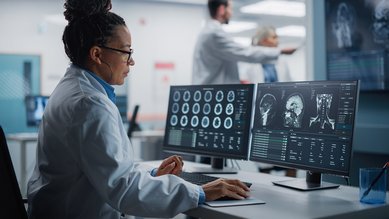
The development of AI-assisted systems for analyzing images is particularly advanced. For example, AI applications are able to analyze X-rays, computed tomography (CT) scans or colonoscopy images. AI applications have already been approved for the detection of:
- various cancers, for example breast cancer, skin cancer or lung cancer
- brain hemorrhages
- broken bones

In studies, many of these applications have even detected suspicious anomalies in the images more reliably than experts. Some AI programs could also help to prevent human error, for example due to waning concentration. Studies to date have indicated that image analysis as a whole can be made more precise and reliable if doctors are supported by AI.
Interesting fact: AI applications that can improve image quality have also been developed. Taking CT scans using low-level radiation results in lower image quality. By using AI applications to improve this, CT scans could be performed using lower levels of radiation while still achieving good image quality.
How can artificial intelligence be used in relation to treatment?
With some medical conditions and in some situations, AI applications could also support treatment in the future. This particularly applies to therapies that are tailored to patients’ specific situations.
Artificial intelligence and diabetes mellitus treatment
In the case of diabetes mellitus, AI can help to optimize treatment involving insulin. If a sensor continually monitors the blood sugar level, AI can use this information to calculate how much insulin is required to optimally regulate the blood sugar. When calculating the amount of insulin, past blood sugar readings are also taken into account, so the AI-assisted system continually adapts to diabetes patients’ individual needs.

Systems that not only measure the blood sugar but also calculate and administer the necessary amount of insulin are known as closed-loop systems. In studies, patients’ blood sugar levels could be regulated more accurately with the aid of AI-based closed-loop systems than with other procedures.
Artificial intelligence and surgery
Artificial intelligence could be used to both plan and perform surgery. When planning joint replacement surgery, an AI application can be used to predict the procedural steps required during surgery on the basis of X-ray images, for example. The program also indicates what size of joint prosthesis is likely to be needed.
Many hospitals use AI-assisted surgical robots for treatment purposes. At present, these are completely controlled by a doctor, but it is conceivable that they could be able to independently perform individual procedural steps or even entire operations in future. In animal tests, a robot developed in the USA has already independently performed demanding intestinal sutures. The results were even better than those of humans.
Personalized medicine
AI applications could help to further develop personalized medicine, i.e. increasingly adapt medical care to patients’ individual needs. To this end, AI applications can consider a huge volume of information from different contexts, including patients’ personal medical history, medication treatment plan and possibly even the results of genetic tests. This could make it possible to choose medication and further treatment steps tailored to patients.
Furthermore, tests would then be offered to targeted, high-risk patients for the early detection of certain medical conditions. AI applications make it possible to predict personal risk with greater accuracy than previously by considering multiple different risk factors, such as patients’ lifestyles or family medical history.
Brain-computer interfaces
Brain-computer interfaces could potentially offer new opportunities with regard to treatment and rehabilitation. These create a direct connection between the brain and a computer or a machine, making it possible, for example, to control a computer with your thoughts. Researchers use artificial neural networks to decode the brain activities.

In a study, a paralyzed patient was able to use a brain-computer interface to move a virtual hand and use it to control a virtual drone. In other individual studies, people no longer able to speak due to paralysis could independently produce speech using a brain-computer interface. However, the technology is not yet sophisticated enough to be used for patients outside studies.
Care
Some special AI applications for care are currently being developed in research projects. These include applications designed to help:
- categorize wound types and improve wound treatment
- improve treatment of diabetic foot syndrome
- determine a patient’s risk of delirium
- assess the risk of falls
How can AI simplify processes in medical facilities?
For processes to run smoothly in medical practices and hospitals, multiple organizational tasks are required, for example:
- Scheduling appointments and assigning them to patients
- Ordering medication and materials
- Documenting consultations, test results and the progression of medical conditions
- Writing doctors’ letters
- Settling the costs of treatments and tests with health insurance funds
- Creating personnel and shift rotas

Organizational tasks take up about quarter of healthcare professionals’ working time. AI-assisted applications could help to perform these quicker, ideally giving staff more time for personal contact with patients.
Artificial intelligence and appointment scheduling
AI-based telephone assistants can be used when patients contact medical practices. These make it easier for them to contact their medical practice by phone as well as to arrange, change or decline appointments. If telephone assistants take calls and independently deal with certain patient matters, practice staff can go about their other duties without interruption. In addition to telephone assistants, chatbots could also help with appointment management.
AI applications for appointment scheduling have been designed to reduce patient waiting times and save costs, among other benefits.
Artificial intelligence for documentation purposes
Medical professionals document all important information, for example in digital patient records. In the future, such documentation tasks could be supported by AI-assisted programs.
For example, AI assistants that listen and automatically take notes during patient-doctor consultations have been trialed and, in some cases, are already being used on an everyday basis. A study has also shown that one such AI assistant was able to save time that would otherwise have been spent documenting the consultation. In some cases, however, the notes made by the AI assistant included errors and the doctors found them too detailed.
Artificial intelligence for writing doctors’ letters
When patients are discharged from hospital, they are given a doctors’ letter. This summarizes the progression of their medical condition for the professionals providing further treatment.
Writing doctors’ letters is often time-consuming. AI applications could be used to speed up the process. At Hamburg University Hospital (UKE Hamburg), for example, a program is used to create part of the doctor’s letter based on test and examination findings and notes from the patient record. A doctor then reviews the text that has been written by the AI program, edits it if necessary and approves it.
How can patients use artificial intelligence?
Chatbots are computer programs that people can communicate with similarly to with a real person. Chatbots based on artificial intelligence (AI), such as ChatGPT, can answer all your questions and provide information about almost any topic.
When people are concerned about their health, they often have a lot of questions, such as whether they need help urgently, what they should do to get better and what they should avoid. Even after a doctor’s appointment, not all questions have always been answered as information is easily forgotten in the heat of the moment and the written diagnosis is often packed with complex specialist terms. It therefore makes sense to ask chatbots about medical matters.
One benefit of doing this is that chatbots provide custom responses to user questions. They can even ask things in return. This differentiates AI-assisted chatbots from health portals, other websites or specialist journals. Compared with a Google query about healthcare matters, chatbots provide better and more comprehensive answers. On the whole, they can therefore make it easier to access health-related information.
In studies to date, the answers to health-related questions provided by chatbots were often correct. However, chatbots also provided answers that doctors regarded as incomplete, partially inaccurate or even dangerous.
Chatbots have not been specially developed for health matters and also have no idea of what is true and what is not. Inaccurate, outdated or purely fictitious answers can be provided. It is hard for people without a medical background to critically assess health-related information, especially as some chatbots provide no or incorrect sources.
symptom checker
Clinical decision aids for laypeople, also known as symptom checkers, are available in the form of apps or websites. They are designed to help people assess their symptoms and determine whether measures such as a doctor’s appointment are necessary. To this end, such apps ask questions about pre-existing conditions and symptoms. Symptom checkers use this information to determine which medical condition is most likely to have caused the symptoms.
Even the National Association of Statutory Health Insurance Physicians (KBV) and health insurance funds use symptom checkers. These should enable patients to make an initial assessment of their symptoms and suggest a suitable way to proceed.
Some symptom checkers use AI to get their results. In a study, these services provided more reliable diagnoses than symptom checkers without AI. However, their recommendations can also be wrong. In one study, a symptom checker overlooked the need for urgent treatment, for example. In far more cases, on the other hand, the symptom checker assessed the need for treatment as more urgent than it actually was. These kinds of overestimates can lead to unnecessary doctor’s appointments.
Important: a suspected diagnosis by a symptom checker should therefore only be regarded as an initial assessment and should be checked through further research if necessary. Although symptom checkers provide rough guidance as to how urgently symptoms should be treated, they are not a substitute for doctor’s appointments.
What restrictions are there on the use of AI in everyday medical life?
Artificial intelligence (AI) has great potential to improve healthcare. To make responsible use of AI in the medical field, however, several challenges must be overcome.
Loss of personal contact and support
Some studies have found that in written correspondence, the medical advice provided by AI-assisted chatbots was perceived as more empathetic than the answers written by medical professionals. Chatbots can explain medical information comprehensively and clearly because they have the capacities that medical professionals are often lacking during their everyday working lives.
Despite this, interpersonal relations cannot be replaced by artificial intelligence. Personal support can even help with the healing process.
Loss of skills
The use of AI could change learning processes and human skills. On the one hand, people may be able to use AI to perform tasks that they would not have been able to manage without it. On the other hand, they could gradually lose certain skills if they continually use the support of AI.
Other challenges
Other major challenges are also associated with the increasing use of AI. For example, AI applications have to be trained using large volumes of suitable data. This data must be of high quality in order to develop reliable AI applications.
Large data centers are generally required to operate AI applications. If AI applications are increasingly used, the data centers consume large amounts of electricity, water and other resources.
Further information about the conditions that should be met when using AI applications can be found in our introductory article on Artificial intelligence in medicine.
- Bundesärztekammer. Von ärztlicher Kunst mit Künstlicher Intelligenz. Stand 05/2025.
- Bundesministerium für Forschung, Technologie und Raumfahrt. Ergebnissteckbriefe. Repositorien und KI-Systeme im Pflegealltag nutzbar machen. Aufgerufen am 14.08.2025.
- Bundy H, Gerhart J, Baek S, et al. Can the Administrative Loads of Physicians be Alleviated by AI-Facilitated Clinical Documentation? J Gen Intern Med. 2024 Nov;39(15):2995-3000.
- Cellina M, Cacioppa LM, Cè M, et al. Artificial Intelligence in Lung Cancer Screening: The Future Is Now. Cancers. 2023; 15(17):4344.
- Deutscher Ethikrat. Mensch und Maschine – Herausforderungen durch Künstliche Intelligenz. Stellungnahme. Stand 20.03.2023.
- Deutsches Ärzteblatt. Gesundheitskompetenz: Dr. Google wird zu Dr. KI. Jg. 122. Sonderausgabe KI. Erschienen am 26.05.2025.
- Drews MA, Demircioğlu A, Neuhoff J, et al. Impact of AI-Based Post-Processing on Image Quality of Non-Contrast Computed Tomography of the Chest and Abdomen. Diagnostics. 2024; 14(6):612.
- Johns Hopkins University. Robot performs first laparoscopic surgery without human help. Aufgerufen am 14.08.2025.
- Khalifa M, Albadawy M. AI in diagnostic imaging: Revolutionising accuracy and efficiency. Computer Methods and Programs in Biomedicine Update. Volume 5, 2024.
- Lernende Systeme – Die Plattform für Künstliche Intelligenz (Hrsg.). KI für bessere Abläufe in Medizin und Pflege. Anwendungen und Potenziale in organisatorischen Prozessen. Whitepaper. Stand: 06.2025.
- Stiftung Gesundheitswissen. Gesundheitsinfos suchen mit KI-Chatbots. Erstellt am 18.03.2025.
- Stiftung Gesundheitswissen. Symptom-Checker: Wie zuverlässig sind Diagnosen per App? Erstellt am 19.03.2025.
- Universitätsklinikum Hamburg-Eppendorf. Erste KI-Anwendung zur Erstellung von Arztbriefen im UKE im Einsatz. Aufgerufen am 14.08.2025.
- Wang X, Si J, Li Y, et al. Effectiveness and safety of AI-driven closed-loop systems in diabetes management: a systematic review and meta-analysis. Diabetol Metab Syndr. 2025 Jun 23;17(1):238.
- Willett, F.R., Kunz, E.M., Fan, C. et al. A high-performance speech neuroprosthesis. Nature 620, 1031–1036 (2023).
- Willsey, M.S., Shah, N.P., Avansino, D.T. et al. A high-performance brain–computer interface for finger decoding and quadcopter game control in an individual with paralysis. Nat Med 31, 96–104 (2025).
As at: