Digital health The e-prescription
Electronic prescriptions are convenient and easy to use. They can be easily redeemed by people with statutory health insurance by having their medical data card scanned in a pharmacy. Hard copies can also still be submitted. Using an app for e-prescriptions can offer additional benefits.
At a glance
- The electronic prescription or e-prescription for short saves patients time and reduces the number of journeys they have to make.
- To use these benefits, people need an electronic medical data card or a smartphone app. E-prescriptions can also still be optionally redeemed as hard copies.
- E-prescriptions can be used in all pharmacies.
- Relatives or acquaintances can also redeem e-prescriptions.
- E-prescriptions cannot be forged and help doctors, pharmacists and health insurance funds cooperate more closely.
What is an e-prescription?
The electronic prescription or e-prescription for short reduces the number of journeys that patients have to make and simplifies workflows for dental practices, medical practices, pharmacies and health insurance funds. People with statutory health insurance can already use e-prescriptions to receive most prescription drugs.
Private health insurers can also authorize the use of e-prescriptions.
How does the e-prescription work?
The e-prescription is generated in the medical practice and securely stored in the telematics infrastructure for about 100 days. The pharmacy can then read the e-prescription by means of the electronic medical data card, the e-prescription app or a prescription code on the hard copy. Once the e-prescription has been redeemed, its status in the telematics infrastructure changes. It is then not possible to reuse the e-prescription.

Good to know: The issuing medical practice, the patient and the pharmacy dispensing the medication are the only ones with access to the data stored in the e-prescription. The data can also be automatically transferred to the electronic patient record (ePA).
Like the paper prescription, the e-prescription can be used flexibly as it does not have to be redeemed by a specific person. If the insured person is unable to redeem it in the pharmacy themselves, relatives or acquaintances can also collect the medication.
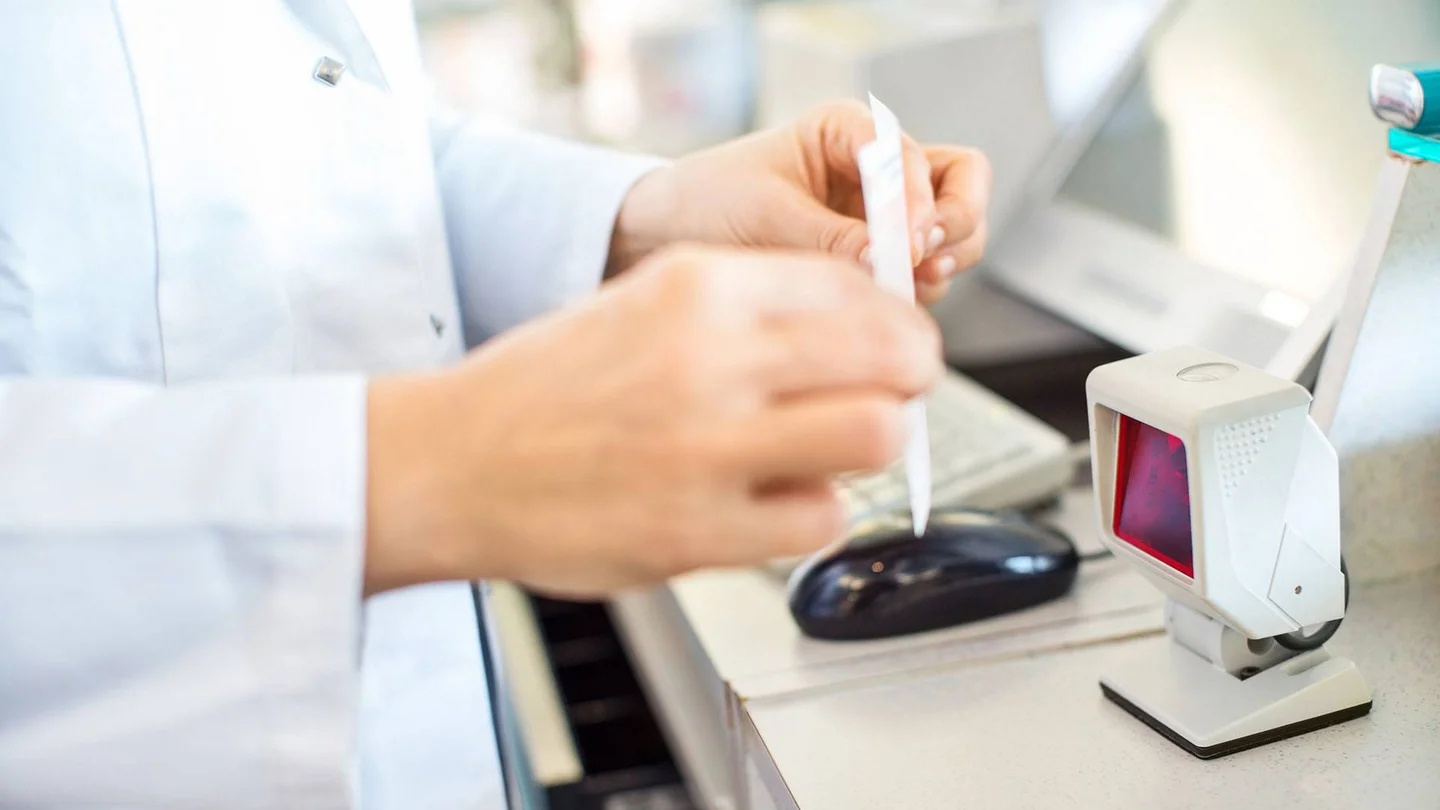
E-prescriptions can be easily redeemed using an electronic medical data card. To this end, simply allow the pharmacy to read the e-prescription on your electronic medical data card. You do not need a pin to do this; you simply need to insert your medical data card into the card reader. The pharmacy can then access the prescription from the telematics infrastructure and dispense the medication.
Alternatively, you can also have the e-prescription printed in the medical practice. The printout shows which medication you have been prescribed. It also features a prescription code, which is scanned in the pharmacy.
How do you use an e-prescription with an app?
The official app “Das E-Rezept” (“the E-Prescription”) is provided by gematik GmbH and is available free of charge from the usual app stores. Patients can use the app on their device to conveniently access an e-prescription and send it to the pharmacy of their choice with just a few taps, ready to collect their medication later.

Filters also make it possible to search for pharmacies according to certain criteria such as “open now” or “courier service”. Users can then choose a pharmacy in which to redeem the prescription. This reserves the medication until it is delivered or collected.
To use e-prescriptions, the smartphone and the electronic medical data card (eGK) must support near field communication (NFC). A PIN for the electronic medical data card is also required. A PIN and medical data card can be obtained from health insurance funds free of charge. Alternatively, people can log in to the e-prescription app using their HealthID. This is also provided by health insurance funds.
Are there any other apps that can be used to redeem e-prescriptions?
Aside from the official e-prescription app provided by gematik, there are several other apps that you can use to digitally receive and redeem your e-prescriptions. These include apps provided by health insurance funds. These apps also offer most of the benefits of the official e-prescription app. Pharmacies furthermore provide apps that you can use to redeem your e-prescriptions, but they have not been officially tested or approved.
What are the benefits of e-prescriptions for people with health insurance?
All e-prescriptions are clearly legible for pharmacies. If the hard copy has been lost, the prescription can still be redeemed using the electronic medical data card or an appropriate app. Alternatively, a new printout can also be obtained from the medical practice.
Redeeming the e-prescription using an electronic medical data card or app saves time and effort. Repeat prescriptions within a quarter can be issued using the e-prescription without the patient having to re-attend the medical practice. E-prescriptions can also be issued during video consultations. They are then available shortly after the consultation.
E-prescription apps also offer further advantages:
- No repeat trips to the pharmacy to order and collect a prescription. Apps can be used to conveniently preorder medication. If the selected pharmacy offers a courier or mail-order service, this makes it far easier for people with restricted mobility in particular to obtain their medication.
- In addition to the prescription codes, the official e-prescription app also displays instructions on how to take the medication and information about the medication prescribed. It also makes it easier to track when which medication was prescribed and collected from a pharmacy.
- Furthermore, following redemption, patients can use the official e-prescription app or the app from their health insurance fund to see which medication was dispensed. If, for example, different medication had to be provided due to a discount agreement, this is indicated.
- If a prescription is not immediately redeemed, the official e-prescription app or the app from the health insurance fund shows the length of time for which it is still valid. Most prescriptions covered by statutory health insurance expire after a maximum of 28 days, after which they can only be redeemed as private prescriptions at the patient’s own cost.
- The e-prescription app also offers a practical family function for carers and parents. To use this, you need to use your family member’s electronic medical data card and PIN to create an additional profile in your app. You will then automatically receive your family member’s prescriptions. This is also possible in parallel; for example, both parents can view their child’s prescriptions. However, these can only be redeemed once.
- The official e-prescription app is also available in other languages and supports the usual accessibility features provided by operating systems.
What are the benefits of e-prescriptions for the healthcare sector?
E-prescriptions simplify the exchange of information and cooperation between doctors, pharmacies and health insurance funds. Sending an e-prescription electronically reduces the chance of errors and the processing time for everyone involved. E-prescriptions therefore help reduce the workload in the healthcare sector. An electronic signature furthermore prevents forgery.
The e-prescription opens up further possibilities in conjunction with the electronic patient record (ePA): The electronic medication list (eML) stores all medication prescribed by e-prescription and issued by a pharmacy after the ePA has been created. This will provide a better overview of current and previous prescriptions to everyone involved in the treatment process (doctors, pharmacists, insurance holders and, in the future, even caregivers).
Further information
Further information on how to use the e-prescription app can be found on the “E‑Rezept: Die App” (“E‑Prescription: The App”) website.
- gematik. Das E-Rezept für Deutschland. Aufgerufen am 10.09.2025.
- gematik. Das E-Rezept für Deutschland: Die App. Aufgerufen am 10.09.2025.
- gematik. Das E-Rezept für Deutschland: Fragen & Antworten. Aufgerufen am 10.09.2025.
As at: