Conditions Corneal irregularity (astigmatism)
ICD codes: H52.2 What are ICD codes?
With astigmatism, also known as corneal irregularity or corneal curvature, light is not focused onto the eye’s retina correctly. As a result, vision becomes blurred, both close-up and at a distance. This sight defect can be corrected by spectacles, contact lenses or, sometimes, surgical intervention.
At a glance
- With astigmatism, light rays are not focused into a single point on the retina, but are instead focused as lines or streaks. As a result, the image is distorted and blurry.
- The cause is usually a curved cornea, or less commonly, an abnormal curvature of the eye’s lens.
- Astigmatism is usually hereditary. It can sometimes hinder the development of a child’s sight.
- In typical cases, vision is unclear both close-up and at a distance.
- Astigmatism can be corrected by spectacles or contact lenses. In adults, it can also be corrected by a surgical procedure – such as laser treatment.
Note: The information in this article cannot and should not replace a medical consultation and must not be used for self-diagnosis or treatment.


What is astigmatism?
With astigmatism, the cornea of the eye, and sometimes the lens too, is irregularly curved. As a result, incoming light beams do not form a dot on the retina, but lines. This distorts the image perceived so that it is blurred. For example, in the dark you would not see a red traffic light as a red point, but rather as a blurry, short red line. Astigmatism is also known as a corneal irregularity.
The term “astigmatism” itself comes from the Greek and means something like “lacking dots”. This type of visual impairment is usually congenital and is often combined with short-sightedness or far-sightedness.
What are the symptoms of astigmatism?
A mild corneal irregularity often causes no problems and goes unnoticed. If it is less mild, the following symptoms may occur:
- objects are seen blurred or distorted
- eyes are strained or painful
- headaches

A feature of astigmatism is that vision is blurred both close-up and in the distance – in contrast to short- or far-sightedness, with which vision is blurred with objects that are either far away or up close.
What causes astigmatism?
The cornea and the lens of the eye refract (bend) the light that enters our eye. The light is thereby focused and converges at a single point. This focal point normally lies on the retina – specifically in the central area of sharpest vision (macula). A particularly large number of visual cells are located there. They convert the light rays into nerve impulses and transmit them to the brain via the optic nerve. This is how a sharp image is created.
The situation is different for astigmatic eyes: in this case, the light rays do not converge on the macula. Instead, they spread out more widely across the retina and form a line. A blurred or distorted image is produced.
The reason for this is usually a corneal irregularity: The cornea covers the iris and pupil and is normally curved evenly in all directions, like a sphere. In the case of astigmatism, however, it is misshapen. In this case, it is more oval – like a ball that someone presses lightly against the ground with their foot. As a result, it does not refract incident light rays uniformly.
Depending on how irregularly the cornea is curved and refracts light, a distinction is made between two forms of astigmatism:
- regular astigmatism: The cornea refracts light more strongly in the vertical than in the horizontal, for example. This form is more common and is normally congenital. Exactly how it develops is not known. The causes appear to be primarily genetic.
- irregular astigmatism: The cornea has a completely uneven curve, causing light to refract at widely varying degrees across many points. This tends to occur later in life, for instance due to certain eye conditions such as a progressive deformation of the cornea into a cone shape known as keratoconus. Injuries or scars – for example, after a corneal inflammation or eye surgery – can also cause it.
Rarely, astigmatism is not caused by a curvature of the cornea, but by a deformed lens or retina.
How common is astigmatism?
As many people do not have a perfectly curved cornea, astigmatism is quite common. However, it is often so mild that people do not notice it at all.
An estimated one third of adults in Germany has a noticeable astigmatism of more than 0.5 diopters. It is more common in older people and people whose parents have astigmatism.
How does an astigmatism progress?
The severity of astigmatism does not usually change over the course of a lifetime. However, sometimes it gets worse – especially if it is caused by certain eye diseases such as a progressive corneal deformation (keratoconus). In addition, a cataract can alter the refractive power of the lens and thereby intensify or alleviate astigmatism.
If astigmatism in children is left untreated, this can lead to permanent visual impairment. If the eyes are affected to varying degrees, the brain suppresses the information from the weaker eye so as not to have to process different images. Vision does not then develop properly and a condition known as lazy eye (amblyopia) develops. With most children, this lazy eye can be corrected with glasses or temporarily patching the stronger eye, for example.
How can astigmatism be detected early on?
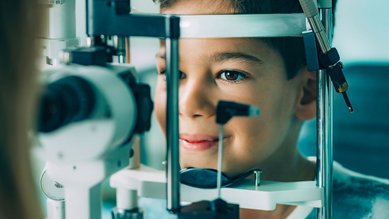
Simple vision tests are part of the routine pediatric developmental check-ups for children. Some pediatric practices can also check the refractive power of the eyes using special devices. If abnormalities are detected, the doctor will refer the child to an ophthalmology specialist practice for a more comprehensive examination.
Parents who are astigmatic themselves are advised to have their child examined by an ophthalmologist by the age of two at the latest.
Employers must offer regular eye examinations by the company physician to people who work at a screen.
How is astigmatism diagnosed?
To diagnose astigmatism, opticians use a range of methods and equipment:
- Placido disc: This is a round disc with colorful circles that you look at. The ophthalmologist checks how the circles are reflected on the cornea: If they are distorted, this is a sign of astigmatism.
- Ophthalmometry: Using a device called an ophthalmometer, the doctor projects two images onto the cornea. The spacing between the images is then adjusted so that they lie exactly on top of each other on the cornea. This is repeated from various angles. The results show how severely the cornea is curved.
- Corneal topography: The surface of the cornea can be measured very precisely using a computer-controlled device (keratograph) and represented like a topographic map featuring mountains and valleys. This is especially necessary in the case of irregular astigmatism or before eye surgery.
Further investigations determine the severity of the visual defect. This is done using special instruments, or through a vision test where the patient reads characters from an eye chart or screen through lenses of varying strengths.
Important: Before the examination, you sometimes receive special eye drops that dilate the pupils. After that, you are not allowed to drive or use machines for a few hours.
How is astigmatism treated?
Mild astigmatism of up to 0.5 diopters is rarely perceived as bothersome – treatment is therefore usually not necessary. More pronounced astigmatism can usually be corrected with glasses or contact lenses. However, glasses do not help with irregular astigmatism – in this case, only rigid (gas-permeable) contact lenses are an option.

There are also various surgical procedures for treating this sight defect. The best method depends, for example, on the severity of the astigmatism and the optician needs to judge this.
Laser beams are often used in corneal surgery. Laser treatment is used to change the curvature of the cornea. Artificial lenses can also be used in the eye to correct the refraction.
Surgical procedures are normally only used with adults and must be paid for out of pocket. With children, an operation is only an option in specific cases that cannot be treated in a different way.
How does astigmatism affect daily life?
If children have poor vision and do not wear vision aids, this can lead to problems at school. Studies have been able to demonstrate this, at least in the case of nearsighted and farsighted children. For instance, children have more difficulty seeing what is on the board and in books. However, their academic performance improved when they received glasses.
If the astigmatism is sufficiently corrected, it usually doesn’t cause any problems in everyday life. However, children may be particularly reluctant to wear glasses – for instance, if they are teased by other children because of them. It can help to let children help choose their glasses, so that they can choose a “cool” model, for example. It is also important that the glasses are fitted as well as possible and sit comfortably.
- Berufsverband der Augenärzte Deutschlands (BVA), Deutsche Ophthalmologische Gesellschaft (DOG). Bewertung und Qualitätssicherung refraktiv-chirurgischer Eingriffe durch die DOG und den BVA – KRC-Empfehlungen: Stand Juni 2022. Ophtalmologie 2023; 120(6): 633-644.
- Dudovitz RN, Izadpanah N, Chung PJ, Slusser W. Parent, Teacher, and Student Perspectives on How Corrective Lenses Improve Child Wellbeing and School Function. Matern Child Health J 2016; 20(5): 974-983.
- Gurnani B, Kaur K. Astigmatism. Treasure Island (FL): StatPearls Publishing; 2023.
- Kam KW, Chee AS, Zhang Y et al. Association of Maternal and Paternal Astigmatism With Child Astigmatism in the Hong Kong Children Eye Study. JAMA Network Open 2022; 5(12): e2247795.
- Lang GK. Augenheilkunde. Stuttgart: Thieme; 2014.
- Mavi S, Chan VF, Virgili G et al. The Impact of Hyperopia on Academic Performance Among Children: A Systematic Review. Asia Pac J Ophthalmol (Phila) 2022; 11(1): 36-51.
- Pschyrembel Online. Astigmatismus. 2024.
- Schiefer U, Kraus C, Baumbach P et al. Refractive errors [Refraktionsfehler. Epidemiologie, Auswirkungen und Behandlungsmöglichkeiten]. Dtsch Arztebl Int 2016; 113(41): 693-702.
- Woltsche N, Werkl P, Posch-Pertl L et al. Astigmatismus. Ophthalmologe 2019; 116(3): 293-304.
- Zhang J, Wu Y, Sharma B et al. Epidemiology and Burden of Astigmatism: A Systematic Literature Review. Optom Vis Sci 2023; 100(3): 218-231.