Healthy living Climate change and pollen: why allergies are on the increase
Many people suffer from allergic rhinitis due to pollen (“hay fever”). Studies indicate that these allergic respiratory diseases are increasing. Climate change is believed to be one of the causes behind this. This article provides more information about the connection between climate change and pollen allergy.
At a glance
- Allergic respiratory diseases are increasing as the climate changes.
- Plants are in bloom for longer overall as average temperatures rise.
- The longer pollen season and increased pollen production are contributing to the rise in allergic respiratory diseases.
- Pollen-related allergies are caused by an overreaction of the body’s immune system to plant pollen, which is actually harmless.
- Around 15 percent of adults in Germany are affected by hay fever.
- Allergic asthma can also be caused by pollen.
Note: The information in this article cannot and should not replace a medical consultation and must not be used for self-diagnosis or treatment.


What is a pollen allergy?
Allergies occur when the body’s immune system over-reacts to substances that are actually harmless, such as pollen circulating in the air. Plants produce pollen for the purpose of reproduction.
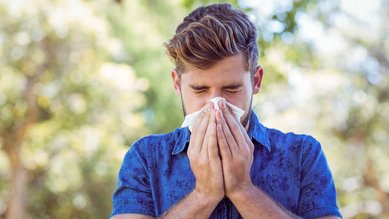
Typical symptoms of a pollen allergy are sneezing, a runny nose, an urge to cough and red, itchy eyes. This is commonly known by the non-scientific term hay fever. Doctors refer to it as “allergic rhinitis”. In Germany, about 15 percent of adults have hay fever.

Bronchial asthma, a chronic respiratory disease, can also be triggered by an allergic reaction to plant pollen. This is then referred to as allergic asthma. Unlike hay fever, the symptoms (mainly shortness of breath and wheezing) come in the form of sudden attacks.
How does climate change affect the pollen count?
The effects of climate change have been felt in Germany for quite some time. These include a rise in the frequency of extreme weather events such as storms or summer heatwaves and a gradual rise in average temperatures. According to the German Meteorological Service DWD, the five hottest years since 1880 did not occur until very recently, between 2019 and 2024. 2024 was the warmest year on record in Germany. While many people are pleased about the longer summers, others increasingly suffer from heat-related health problems – particularly cardiovascular symptoms.
But how do these climate changes in Germany and Europe affect plants, their flowering periods and the spread of pollen? And what might the consequences be for people with pollen-related allergies?
Put simply, the increase in temperatures is also causing a change and shift in the seasons: autumn and winter are becoming milder in terms of their average temperatures. Spring and summer are becoming longer and hotter. Plants are starting to flower earlier and for longer.
Flowering periods are longer overall, resulting in longer periods with a high pollen count. Another factor is that species of plants not previously native to Germany are establishing themselves here as the temperatures rise. One of the main plants that causes pollen allergy is common ragweed (Ambrosia artemisiifolia). It has several other common names, including annual ragweed and low ragweed. It originated in North America and was introduced in Europe as a result of increasing global trade. The pollen produced by this plant is particularly likely to cause allergies.
Another factor in the increased pollen count is believed to be the increase in carbon dioxide (CO2) levels in the atmosphere, which can increase pollen production in many plants. If correct, that would mean that CO2 emissions from households, industry and traffic are not only a major contributor to global warming; they could also be partly responsible for the rise in pollen-related respiratory disease.
Video What impact does climate change have on health?
This video shows how some conditions are spreading as a consequence of climate change. Rising temperatures have consequences for people’s health.
This and other videos can also be found on YouTube
Watch nowThe privacy policy indicated there applies.
What are the consequences of climate change for people with a pollen allergy?
Increased exposure to pollen can exacerbate existing allergies and prolong the acute symptom phases.

Climate change can increase exposure to pollen in several ways:
- Many plants are starting to produce pollen earlier.
- The pollen season is becoming longer.
- Many plants are producing more pollen.
- Plant species, including those like common ragweed that have a high allergy potential, are spreading.
Climate change also has other consequences that can contribute to or exacerbate chronic diseases of the respiratory tract, such as allergic asthma caused by pollen.
- More frequent heatwaves and higher temperatures: these make respiratory diseases more severe. Heat and dryness increase exposure to pollutants in the air, which irritates the respiratory system.
- Heavier rainfall with flooding: this increases the humidity in the air. High humidity can increase airway resistance. Mold forms more easily, which can trigger allergic asthma. Allergens, i.e., substances that trigger allergies, can also be spread through tiny droplets in the air.
- More frequent extreme weather events, such as storms: There are indications that the dispersal of airborne pollen can change suddenly during storms, potentially triggering asthma attacks.
Important: Additional factors such as air pollution with particulate matter can also make respiratory disease more likely or exacerbate it.
How can you protect yourself against pollen?
There are ways for people with pollen allergies to respond to an increase in the pollen count and mitigate symptoms if possible:
- Outdoor activities should be avoided as far as possible when the airborne pollen count is particularly high.
- It can be useful to keep windows shut when the pollen count is high. It’s best to air rooms when the pollen count is low according to the pollen count forecast.
- Doctors can prescribe medication to treat the allergy and adjust the prescription as needed.
- Targeted immunotherapy (hyposensitization) can reduce or even neutralize the allergic reaction under certain circumstances. With this type of treatment, the immune system becomes desensitized or used to the allergy-causing pollen, so that it no longer overreacts to it. This type of treatment normally produces effects that last for several years.
The German Pollen Information Service (Stiftung Deutscher Polleninformationsdienst, PID) provides pollen forecasts that allow you to adjust your activities and, if necessary, your medication based on the current pollen count. For example, the PID website provides daily and weekly pollen forecasts.
Where can I find more information?
Detailed information about the topic of climate change and allergies can be found on the allergieinformationsdienst.de. website (in German).
More information about protecting yourself from allergies is available on the klima-mensch-gesundheit.de web portal operated by the Federal Institute for Public Health (Bundesinstitut für Öffentliche Gesundheit, BIÖG).
- Allergieinformationsdienst. Klimawandel und Allergie. Aufgerufen am 23.09.2025.
- Allergieinformationsdienst. Heuschnupfen. Aufgerufen am 23.09.2025.
- Bergmann KC et al. Impact of climate change on allergic diseases in Germany. J Health Monit. 2023 Sep 6;8(Suppl 4):76-102.
- Deutsches Ärzteblatt. Klima und Gesundheit: Klimaresilienz – Weg der Zukunft. 2020. Jg. 117, Heft 33-34, A1556-1558.
- D'Amato G et al. Thunderstorm allergy and asthma: state of the art. Multidiscip Respir Med. 2021 Dec 2;16(1):806.
- Deutscher Wetterdienst (DWD). Klima und Umwelt. Aufgerufen am 23.09.2025.
- Eguiluz-Gracia I, Mathioudakis AG, Bartel S et al. The need for clean air: The way air pollution and climate change affect allergic rhinitis and asthma. Allergy. 2020 Sep; 75(9): 2170-2184.
- Lungeninformationsdienst. Asthma: Symptome, Formen, Entstehung. Aufgerufen am 23.09.2025.
- Stiftung Deutscher Polleninformationsdienst. Beifuß-Ambrosie. Aufgerufen am 23.09.2025.
- Umweltbundesamt. Beobachtete und erwartete Klimafolgen in Deutschland. Aufgerufen am 23.09.2025.
- Umweltbundesamt. Trends der Lufttemperatur. Aufgerufen am 23.09.2025.
As at: