Conditions Torn muscle
ICD codes: T14.6 What are ICD codes?
Sharp movements, for example during a sports activity, can cause torn muscles. A torn muscle usually becomes apparent when there is a sudden, shooting pain. It usually heals without any after-effects, but this takes a while.
At a glance
- Muscles are often torn when making sharp movements during sports, such as football or tennis.
- This occurs due to excessive strain or load being placed on the musculature.
- For torn muscles to heal, rest and ice are important.
- Patience is also required because healing takes several weeks.
- The injury usually heals by itself with no after-effects.
- There is no scientific proof that treatments involving bandages, tapes or therapies using the patient’s own blood and tissue have any effect.
Note: The information in this article cannot and should not replace a medical consultation and must not be used for self-diagnosis or treatment.


What is a torn muscle?
When people move, they put strain on their muscles. The muscles consist of various structural components – individual muscle fibers form bundles of fibers, which are then grouped together to form a whole muscle.
When excessive strain is placed on a muscle during exercise, muscle fibers can become overstretched until they tear. If the injury only involves overstretching, the result is muscle strain (also known as a pulled muscle).
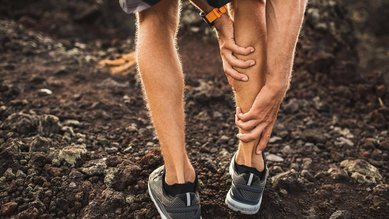
A torn muscle involves one or more fibers tearing. This injury usually becomes apparent when there is a sudden pain in the relevant limb. Depending on the severity, it may be impossible to put any weight or strain on it, and it may initially be almost impossible to move it.
Torn muscles often occur when someone is doing a sports activity involving quick movements, sprints, turns and stops. These include tennis, football and rugby, for instance.
Fatigue, insufficient warm-ups before training, and various other factors can increase the risk of a torn muscle.
A torn muscle usually heals on its own. However, some rapid actions immediately after the injury, such as applying an ice pack, are advisable.
What are the symptoms of a torn muscle?
A torn muscle typically involves a sudden, shooting pain. This continues until the person is hardly able to put any weight or strain on the muscle group or limb.
When muscle fibers tear, a popping or snapping sound is often heard. In cases of deep tears or if the muscle is completely torn, the affected leg may give way, possibly resulting in a fall.
The pain of a torn muscle intensifies when you press on the injured area or stretch the muscle. Sometimes a visible bruise (hematoma) forms.

People with a torn muscle often adopt an incorrect, protective posture, putting all their weight on one leg and limping, for example.
There may also be a bump or swelling in the affected area, as well as visible bruising.
What causes a torn muscle?
When a muscle tears, tiny parts of the muscle are torn apart. The individual fibers form bundles which altogether make up a muscle.
The injury typically affects skeletal muscles, e.g. the biceps femoris, which is located at the back of the thigh and flexes the leg.
Excessive strain or, more rarely, bangs or accidents, can briefly exert forces on the muscle that it is unable to withstand. Consequently, the fibers tear.
What are the risk factors for a torn muscle?
Various factors increase the risk of a torn muscle. The most common include:
- training too hard, excessive strain
- the muscles being very tired
- not warming up, or not doing it properly
- lack of muscle flexibility
- muscle weakness
Previous muscle injuries also increase the risk of getting a torn muscle.
Another factor that makes a torn muscle more likely to occur is being older.
How common is a torn muscle?
Torn muscles are among the most common sports injuries. As a rough estimate, they make up a third of all sports injuries. However, these are usually minor injuries, such as a muscle strain.

What is the outlook for a torn muscle?
A torn muscle usually heals without any complications or long-term consequences. However, this is only possible if the injury is looked after properly.
Healing can take quite a long time. Depending on the severity of the torn muscle, it takes 2 to 6 weeks until full weight-bearing is possible – sometimes even longer.
Important: If the injured person begins exercising again before the torn muscle has healed, they are at an increased risk of being injured again.
How can torn muscles be prevented?
To prevent muscle injury, training should match the individual’s capabilities, and placing excessive strain on muscles should be avoided.
It’s also important to warm up before the activity.
How is a torn muscle diagnosed?
When a torn muscle is suspected, it is a good idea to consult the family doctor or a specialist in sports medicine. First, the doctor will ask about the case history – when did the pain first appear? Can weight still be put on the leg?
Doctors usually identify a torn muscle through the typical symptoms. A physical examination enables the doctor to see whether there is any swelling at the site or whether there is any missing tissue that could indicate that the entire muscle is torn.
Sometimes, an ultrasound or MRI is performed to confirm the diagnosis or rule out other injuries – such as a complete muscle tear or a tendon or bone injury.
How is a torn muscle treated?
Doctors recommend an initial treatment known as RICE:
- R for rest: stop exercising and rest
- I for ice: apply an ice-pack to the injury
- C for compression: put on a compression bandage
- E for elevate: raise the relevant part of the body
These initial measures aim to reduce bleeding in the tissue and swelling in order to prevent further damage. Over-the-counter painkillers such as paracetamol or ibuprofen can be taken for a few days to relieve the pain.
Torn muscles usually heal on their own. After the rest period, it is advisable to start with modified movements and not to immobilize the leg for too long. The important thing is for the movements to be as pain-free as possible. A mild pulling sensation is not a problem. Sometimes, your doctor may also refer you to a physiotherapist who can support your recovery and help prevent a future muscle injury.
Surgery is rarely necessary. Reasons for surgery include a very deep or complete muscle tear or an impending compartment syndrome.
- Crossley KM, Patterson BE, Culvenor AG et al. Making football safer for women: a systematic review and meta-analysis of injury prevention programmes in 11 773 female football (soccer) players. Br J Sports Med 2020; 54(18): 1089-1098.
- Freckleton G, Pizzari T. Risk factors for hamstring muscle strain injury in sport: a systematic review and meta-analysis. Br J Sports Med 2013; 47(6): 351-358.
- Graf C. Lehrbuch Sportmedizin: Basiswissen, präventive, therapeutische und besondere Aspekte. Köln: Deutscher Ärzteverlag; 2011.
- Green B, Bourne MN, van Dyk N et al. Recalibrating the risk of hamstring strain injury (HSI): A 2020 systematic review and meta-analysis of risk factors for index and recurrent hamstring strain injury in sport. Br J Sports Med 2020; 54(18): 1081-1088.
- Hotfiel T, Seil R, Bily W et al. Nonoperative treatment of muscle injuries - recommendations from the GOTS expert meeting. J Exp Orthop 2018; 5(1): 24.
- Kieb M, Lorbach O, Engelhardt M. Muskelverletzungen: Diagnostik und Behandlungen. Orthopade 2010; 39: 1098-1107.
- Klein C. Orthopädie für Patienten. Remagen: Michels-Klein; 2014.
- Lemes IR, Pinto RZ, Lage VN et al. Do exercise-based prevention programmes reduce non-contact musculoskeletal injuries in football (soccer)? A systematic review and meta-analysis with 13 355 athletes and more than 1 million exposure hours. Br J Sports Med 2021; 55(20): 1170-1178.
- Müller-Wohlfahrt HW, Ueblacker P, Hänsel L. Muskelverletzungen im Sport. Thieme; 2018.
- Niethard FU, Pfeil J, Biberthaler P. Duale Reihe Orthopädie und Unfallchirurgie. Stuttgart: Thieme; 2017.
- Poudel B., Pandey S. Hamstring Injury. Treasure Island (FL): StatPearls Publishing; 2022.
- Riepenhof H, McAleer S, Delvescovo R et al. Sportverletzungen - Möglichkeiten und Grenzen der konservativen Therapie. Trauma und Berufskrankheit 2018; 20: 265-271.
- Rodgers CD, Raja A. Anatomy, Bony Pelvis and Lower Limb, Hamstring Muscle. Treasure Island (FL): StatPearls Publishing; 2022.
- Rudisill SS, Varady NH, Kucharik MP et al. Evidence-Based Hamstring Injury Prevention and Risk Factor Management: A Systematic Review and Meta-analysis of Randomized Controlled Trials. Am J Sports Med 2022 [Epub ahead of print].
- Van der Horst N, van de Hoef S, Reurink G et al. Return to Play After Hamstring Injuries: A Qualitative Systematic Review of Definitions and Criteria. Sports Med 2016; 46(6): 899-912.
- Van Dyk N, Behan FP, Whiteley R. Including the Nordic hamstring exercise in injury prevention programmes halves the rate of hamstring injuries: a systematic review and meta-analysis of 8459 athletes. Br J Sports Med 2019; 53(21): 1362-1370.
- Vatovec R, Kozinc Z, Šarabon N. Exercise interventions to prevent hamstring injuries in athletes: A systematic review and meta-analysis. Eur J Sport Sci 2020; 20(7): 992-1004.