Conditions Abdominal aortic aneurysm
ICD codes: I71 What are ICD codes?
If part of the abdominal aorta stretches and bulges outward, doctors refer to this as an abdominal aortic aneurysm. It occurs more frequently in men than women. In most cases, an abdominal aortic aneurysm doesn’t cause any serious problems. If it ruptures, however, this is an emergency that must be treated immediately.
At a glance
- If part of the aorta in the abdomen (tummy) stretches and bulges out, this is known as an abdominal aortic aneurysm.
- It usually doesn’t cause any symptoms and remains unnoticed.
- If the abdominal aortic aneurysm ruptures (breaks open), this is a life-threatening emergency.
- The size of the aneurysm and other risk factors indicate how likely a rupture is.
- About 2% of all men between the ages of 65 and 75 have an abdominal aortic aneurysm. Women are much less likely to have one.
- Men over the age of 65 can avail of screening for abdominal aortic aneurysms as part of their health check-up.
Note: The information in this article cannot and should not replace a medical consultation and must not be used for self-diagnosis or treatment.
What is an abdominal aortic aneurysm?
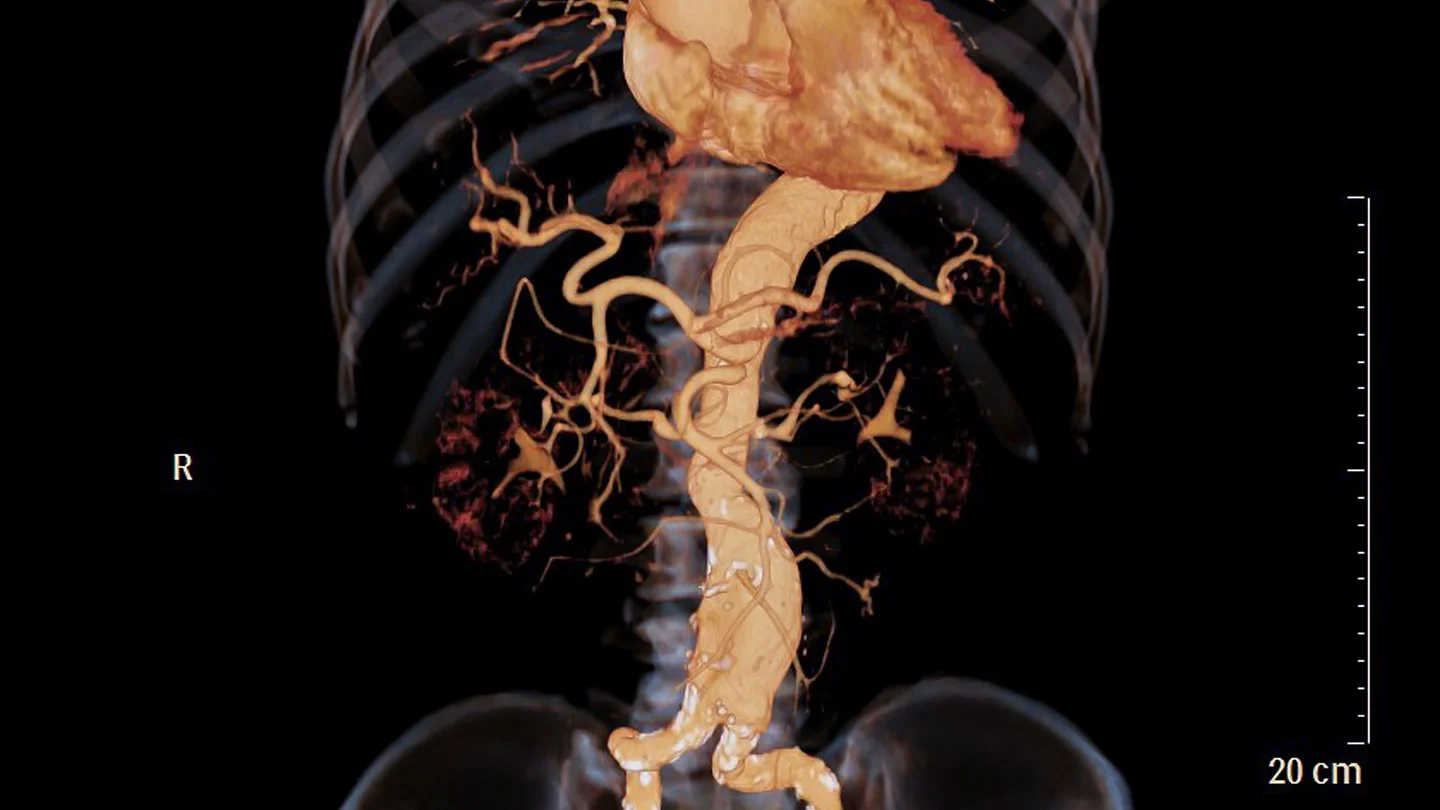
The term abdominal aortic aneurysm describes an abnormal enlargement of part of the abdominal aorta.
The aorta is the artery that carries oxygen-rich blood from the heart to the rest of the body. The part of the aorta that runs through the abdomen is called the abdominal aorta. If it expands at any point by at least half its normal diameter, it is called an abdominal aortic aneurysm.
An abdominal aortic aneurysm typically doesn’t cause any symptoms and most aneurysms are harmless. However, as the size increases, so does the risk of the abdominal aorta suddenly rupturing. That is an emergency situation and life-threatening.
What are the symptoms of an abdominal aortic aneurysm?
Most abdominal aortic aneurysms do not cause any symptoms and often go undetected.
Larger aneurysms can cause pain in the back, abdomen, or side.
If the abdominal aorta ruptures, it causes sudden back pain that radiates to the sides or groin. It may be accompanied by nausea and vomiting, heavy sweating, or shortness of breath. A large amount of blood is lost through the rupture, The brain and other organs then no longer receive enough oxygen. which may cause dizziness, loss of consciousness and eventually circulatory collapse.
What causes an abdominal aortic aneurysm?
An abdominal aortic aneurysm can develop when the elasticity of the blood vessel wall decreases. The elasticity decrease with age and also when the vessel is under considerable strain, such as from high blood pressure. Smoking also increases the risk of developing an abdominal aortic aneurysm. In rare cases, inflammatory processes can also lead to an aneurysm.
If one part of the vessel wall starts bulging, it tends to continue to expand, Therefore, the aneurysm usually grows larger over time.
What factors increase the risk of developing an abdominal aortic aneurysm?
Several factors increase the risk of an abdominal aortic aneurysm. They are:

- Sex: men are significantly more likely to develop an abdominal aortic aneurysm than women.
- Age: the risk increases with age. Most people who have an abdominal aortic aneurysm are over 65 years old.
- Smoking: smoking is the most significant risk factor over which a person has control.
- High blood pressure, cardiovascular diseases or chronic obstructive pulmonary disease (COPD) increase the risk of an aneurysm.
- Blood lipids: high levels of blood lipids (blood fats) increase the likelihood of an aneurysm developing.
- Genetic predisposition: having close relatives with an abdominal aortic aneurysm or rare, genetic connective tissue diseases also increases the risk.
How often does an abdominal aortic aneurysm occur?
About 2 percent of all men between the ages of 65 and 75 have an abdominal aortic aneurysm.

The risk increases with age. Women are much less likely to have an abdominal aortic aneurysm – less than 1 percent of women aged 60 and older are affected.
How does an abdominal aortic aneurysm develop?
In most cases, an abdominal aortic aneurysm causes no symptoms and remains harmless. If it widens, this usually only happens at a slow rate.
Only some aneurysms become so large that there is an increased risk of the aorta suddenly rupturing. If the aorta ruptures, a large amount of blood leaks into the abdominal cavity – which is a life-threatening emergency.
The risk of an aneurysm rupturing is higher if the aneurysm is growing rapidly or if it has reached a certain size.
In men, this is a diameter of at least 5.5 centimeters. It is roughly estimated that abdominal aortic aneurysms with a diameter between 5.5 and 7 centimeters will rupture within one year in about 1 to 5 out of 100 men. With a diameter of 7 centimeters or above, the risk of a rupture is many times higher.
Medical professionals estimate that in women, the risk of a rupture increases significantly from a size of about 5 centimeters. An aneurysm with a size between 5 and 5.4 centimeters typically ruptures within a year in up to 3 out of 100 women.
How is an abdominal aortic aneurysm diagnosed?
Abdominal aortic aneurysms are diagnosed using ultrasound imaging. The diameter of the abdominal aorta can be measured in this way. An aneurysm is usually defined as a bulge of 3 centimeters or more. Because the abdominal aorta is narrower in women, the condition is sometimes diagnosed when the aneurysm is slightly smaller.
If an abdominal aortic aneurysm is causing symptoms, it is usually discovered during diagnostic tests.
Can screening ensure early detection of an abdominal aortic aneurysm?
Early detection of an abdominal aortic aneurysm is possible using ultrasound imaging. Surgical intervention can then prevent large aneurysms from becoming large enough to rupture. If smaller bulges are detected, these can be checked regularly to see whether they are growing, and how quickly.
It has been shown that screening for men over the age of 65 lowers the risk of an abdominal aortic aneurysm rupturing and causing death. Only one high-quality study has investigated aneurysm screening tests for women. It shows that screening doesn’t have any advantages for women.
For men aged 65 and over, statutory health insurance funds in Germany offer screening for an abdominal aortic aneurysm.
Important: Screening also has disadvantages. If doctors detect an aneurysm, it may be surgically repaired even though it may never have led to any health problems for the patient. In other words, screening may result in overdiagnosis. In addition, the surgical procedure itself may cause serious complications. Moreover, it may be very distressing for someone to discover that they have an aneurysm.
More information on abdominal aortic aneurysm screening can be found in the Joint Federal Committee (B-GA) brochure.
How is an abdominal aortic aneurysm treated?
Various factors will determine whether an abdominal aortic aneurysm will benefit from treatment and which form of treatment is most suitable. The size and growth of the aneurysm are particularly important, but so is a person’s general state of health.
Smaller abdominal aortic aneurysms – measuring less than 5.5 cm in men and less than about 5 cm in women – are typically monitored on a regular basis.
Those who smoke should quit if possible because smoking can cause the aneurysm to grow. If you have underlying conditions like high blood pressure or high cholesterol, treatment is recommended.
If the risk of rupture is high, surgery is the only preventive measure. There are two options:
- Open surgery through an abdominal incision (cut): the aneurysm is opened, and replaced by an artificial vessel (graft).
- Endovascular procedure through a small incision in the groin: a small tube (stent) is put through the incision into the artery, pushed along to where the aneurysm is, and implanted in the aneurysm.
Both of these procedures are associated with risks, and should be assessed and evaluated individually. As well as the risks associated with a surgical procedure, there is a possibility that the aneurysm may suddenly rupture.
A second medical opinion can make the decision easier. Doctors who recommend surgery for an abdominal aortic aneurysm must point out the right to a free second opinion.
More detailed information about abdominal aortic aneurysms, such as when an operation is appropriate, and a decision-making aid, can be found at gesundheitsinformation.de.
What is involved in rehabilitation following surgery for an abdominal aortic aneurysm?
Open surgery on the abdominal aorta is a major procedure. Therefore, this treatment is often followed by rehabilitation. It is intended to help with recovery from the surgery, improve quality of life, and restore fitness for everyday life.
What is important to know about everyday life with an abdominal aortic aneurysm?
Being diagnosed with an abdominal aortic aneurysm may trigger contradictory emotions. Some people are happy that their aneurysm was discovered, and the check-ups help make them feel safe.
Others would rather have not found out about the aneurysm. Knowing about it can be scary and troubling.
Many people with a diagnosed abdominal aortic aneurysm have to continue living their lives knowing that they are at risk. Symptoms such as abdominal pain can be frightening, as they are often thought to be associated with the aneurysm, even if that’s not actually the case. Many people affected stop doing certain things in everyday life out of fear. They become more careful, and avoid physical exertion, even though this may not be necessary.
- Ali MU, Fitzpatrick-Lewis D, Kenny M et al. A systematic review of short-term vs long-term effectiveness of one-time abdominal aortic aneurysm screening in men with ultrasound. J Vasc Surg 2018; 68(2): 612-623.
- Antoniou GA, Antoniou SA, Torella F. Editor's Choice - Endovascular vs. Open Repair for Abdominal Aortic Aneurysm: Systematic Review and Meta-analysis of Updated Peri-operative and Long Term Data of Randomised Controlled Trials. Eur J Vasc Endovasc Surg 2020; 59(3): 385-397.
- Deutsche Gesellschaft für Gefäßchirurgie und Gefäßmedizin - Gesellschaft für operative, endovaskuläre und präventive Gefäßmedizin (DGG). S3-Leitlinie zu Screening, Diagnostik, Therapie und Nachsorge des Bauchaortenaneurysmas. AWMF-Registernr.: 004-014l (in Überarbeitung). 2023.
- Golledge J, Singh TP. Effect of blood pressure lowering drugs and antibiotics on abdominal aortic aneurysm growth: a systematic review and meta-analysis. Heart 2021; 107(18): 1465-1471.
- Guirguis-Blake JM, Beil TL, Senger CA, Coppola EL. Primary Care Screening for Abdominal Aortic Aneurysm: A Systematic Evidence Review for the U.S. Preventive Services Task Force. (AHRQ Evidence Syntheses; No. 184). 2019.
- Guirguis-Blake JM, Beil TL, Senger CA, Coppola EL. Primary Care Screening for Abdominal Aortic Aneurysm: Updated Evidence Report and Systematic Review for the US Preventive Services Task Force. JAMA 2019; 322(22): 2219-2238.
- Institut für Qualität und Wirtschaftlichkeit im Gesundheitswesen (IQWiG). Ultraschall-Screening auf Bauchaortenaneurysmen: Abschlussbericht; Auftrag S13-04. 2015.
- Institut für Qualität und Wirtschaftlichkeit im Gesundheitswesen (IQWiG). Versicherteninformation zum Ultraschall-Screening auf Bauchaortenaneurysmen – Addendum zum Auftrag S13-04; Auftrag P16-01. 2016.
- Isselbacher EM, Preventza O, Hamilton Black J et al. 2022 ACC/AHA Guideline for the Diagnosis and Management of Aortic Disease: A Report of the American Heart Association/American College of Cardiology Joint Committee on Clinical Practice Guidelines. Circulation 2022; 146(24): e334-e482.
- Lancaster EM, Gologorsky R, Hull MM et al. The natural history of large abdominal aortic aneurysms in patients without timely repair. J Vasc Surg 2022; 75(1): 109-117.
- Mazzolai L, Teixido-Tura G, Lanzi S et al. 2024 ESC Guidelines for the management of peripheral arterial and aortic diseases: Developed by the task force on the management of peripheral arterial and aortic diseases of the European Society of Cardiology (ESC) Endorsed by the European Association for Cardio-Thoracic Surgery (EACTS), the European Reference Network on Rare Multisystemic Vascular Diseases (VASCERN), and the European Society of Vascular Medicine (ESVM). Eur Heart J 2024; 45(36): 3538-3700.
- National Institute for Health and Care Excellence (NICE). Abdominal aortic aneurysm: diagnosis and management (NICE Guidelines; No. NG156). 2020.
- Paravastu SC, Jayarajasingam R, Cottam R et al. Endovascular repair of abdominal aortic aneurysm. Cochrane Database Syst Rev 2014; (1): CD004178.
- Parkinson F, Ferguson S, Lewis P et al. Rupture rates of untreated large abdominal aortic aneurysms in patients unfit for elective repair. J Vasc Surg 2015; 61(6): 1606-1612.
- Wanhainen A, Van Herzeele I, Bastos Goncalves F et al. Editor's Choice - European Society for Vascular Surgery (ESVS) 2024 Clinical Practice Guidelines on the Management of Abdominal Aorto-Iliac Artery Aneurysms. Eur J Vasc Endovasc Surg 2024; 67(2): 192-331.