Care Medical aids – cost coverage and co-payment
Aids such as hearing aids, prosthetics or wheeled walkers are sometimes indispensable to patients in the treatment of or compensation for their health conditions or disabilities. The costs may be partly or fully covered by statutory health insurance funds. However, people usually have to make a co-payment.
At a glance
- Medical aids are products that support medical treatment, prevent a potential disability or compensate for an existing disability.
- Medically necessary aids can be applied for from health insurance funds. A medical prescription may be required. Most of the cost is covered if the medical aid is deemed to be medically necessary.
- However, patients usually also need to make a contribution to the cost themselves. This cost is known as a co-payment or an out-of-pocket cost (“Zuzahlung” in German). It may also be simply referred to as an additional payment or contribution.
- For people with private health insurance, cost reimbursement depends on the individual level of cover.


What are medical aids?
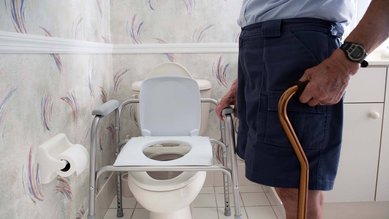
Medical aids are movable items that support the treatment of people with health conditions or disabilities, assist in their recovery or compensate for a disability. They include, for example, hearing aids, prosthetics, wheeled walkers and orthopedic aids. Incontinence aids, inhalation devices and compression stockings are also considered to be medical aids.
For those with statutory health insurance, health insurance funds will cover part or all of the cost of medical aids providing they are medically necessary. If medical aids or additional services other than those medically necessary are selected, people must bear the additional costs and any potential follow-on costs themselves. The entitlement to medical aids also includes everything that may be necessary for their use, such as adjustments, maintenance and repair.

People who have private health insurance and are paying the agreed rate for the relevant level of cover can submit a claim to have the costs of medical aids reimbursed by their private health insurance provider.
It is important to note that medical aids (“Hilfsmittel” in German) are not to be confused with therapeutic services (“Heilmittel”). These are treatments provided by specially trained therapists rather than family doctors – for example, physiotherapy or speech therapy.
How do I submit a claim to have medical aids paid for by my health insurance fund?
Medical aids often have to be prescribed by a doctor for health insurance funds to cover their costs. In other words, you usually need a prescription. You then need to send the prescription, together with your claim, in written form, to your statutory health insurance fund, asking for the cost to be covered. The insurance provider will check your claim and tell you what the next steps are.
You can choose freely between all medical aid providers with which your health insurance fund has entered into an agreement. Your health insurance fund will tell you which these are. It may be possible to hire medical aids that are only needed on a temporary basis and can be used again by another person. This is the case, for example, if a wheelchair is required for a certain time only.
Prerequisites for cost coverage
Certain prerequisites must be met in order for a statutory health insurance fund to cover the cost of a medical aid. For example, the medical aid must be needed:
- to safeguard the success of a treatment
- to prevent a medical condition from deteriorating
- to compensate for a disability on an everyday basis
If the health insurance fund determines that the prerequisites are not met, they will send you confirmation of their decision.
The health insurance fund may not require you to submit a claim for prior approval for certain medical aids. This may be the case, for example, with medical aids that fall below a certain price threshold. If in doubt, find out from your health insurance fund in advance whether a written claim is required. It is not possible to claim for the approval of medical aids in retrospect.
Medical aids for care and other life situations
Under certain conditions, long-term care insurance will cover care aids for people with a care grade of 1 or above. Care aids are medical aids that make home care easier, help to alleviate the care recipient’s symptoms or help people in need of care to lead a more independent life. Examples include care beds or home emergency call systems. As well as these kinds of technical care aids, there are also some consumable aids that are covered by long-term care insurance. Seek advice if necessary from your long-term care insurance fund or the private insurance provider with which you have a long-term care insurance policy.
If a medical aid is required for work or education, the costs are covered by pension insurance, statutory accident insurance, the Integration Office or the Federal Employment Agency, depending on the individual circumstances.
A patient’s health insurance fund is usually the right point of contact. If you have applied for a medical aid from the wrong service provider, don’t worry: It must forward your application to the responsible service provider.
For which aids can the costs be covered?
For most medical aids, the health insurance fund will cover the full cost. However, the co-payment rule applies, i.e. you must pay 10 percent of the cost yourself, although this is limited to a minimum of 5 euros and a maximum of 10 euros. Your own contribution to the cost may exceed this maximum in exceptional cases. Co-payment does not apply to aids for children and adolescents.
Most medical aids are available in various versions. Health insurance covers all costs for your care with medically required medical aids. If you would like a model that goes beyond what is medically necessary, you will have to cover the excess cost and any follow-on costs yourself.
If you have private health insurance, costs are reimbursed on the basis of your agreed rate of cover and the corresponding catalog or index of reimbursable costs.


Where can I find a list of aids that are approved for cover?
The products covered by statutory health insurance are defined in a special directory. This is known as the directory of medical aids and is created by the National Association of Statutory Health Insurance Funds (GKV-Spitzenverband).
For an overview of products covered by health insurance, see the National Association of Statutory Health Insurance Funds online directory.
In some cases, however, products that are not listed there may still be covered by your statutory health insurance fund. It is necessary to supply a documented reason why the medical aid is required in your individual case.
Private health insurance providers also have lists or catalogs of medical aids for which costs may be reimbursed, depending on the policyholder’s level of cover. These specify both the products approved and the maximum amounts that can be reimbursed. Note that private health insurance providers offer certain levels of cover at which the costs of medical aids are reimbursed in full.
Which medical aids are not covered by health insurance funds?
The following aids are excluded from the list of aids approved for cover by the statutory health insurance funds:
- items with little or no documented therapeutic benefits, such as hot-water bottles
- low-price items such as alcohol swabs
- items for general use in daily life, such as cushions or phones. People with a visual impairment can pay for specially adapted items for everyday use from their monthly disability benefits.
For information about accessible living, see the article Accessible living: information on renovations and aids.
What can I do if my application for a medical aid is declined?
Your health insurance fund may reject your claim. You then have one month in which to lodge an appeal if you wish to do so. While it is not mandatory to specify a reason, it increases the chance of success. The reason should explain why the medical aid is medically necessary in your individual case. It is also beneficial to ask your doctor to write a report and attach this to your appeal.
If you are in need of care and your application for a medical aid has been declined, check whether your entitlements under long-term care insurance have also been reviewed. Long-term care insurance may be able to cover the cost of a care aid.
The article Appealing a decision by a health insurance fund explains how to lodge an appeal against a decision by your health insurance fund and important points to note during the process.
Where can I get advice and further information?
The Independent Patient Advice Service for Germany (Stiftung Unabhängige Patientenberatung Deutschland – UPD) offers free advice on issues relating to healthcare and healthcare legislation, including questions about medical aids.
Advice and support relating to medical aids is also provided by social associations, self-help organizations, welfare associations and some consumer advice centers.
People with disabilities can also find contact details for advice centers that can provide assistance in relation to medical aids on the REHADAT Hilfsmittel internet portal.
The complementary independent participation counseling service (Ergänzende unabhängige Teilhabeberatung – EUTB®) provides advice on all matters relating to participation. This includes medical aids.
- Bundesministerium der Justiz. Sozialgesetzbuch (SGB). Fünftes Buch (V) - Gesetzliche Krankenversicherung - (Artikel 1 des Gesetzes v. 20. Dezember 1988, BGBl. I S. 2477) § 33 Hilfsmittel. Stand: 25.02.2025.
- Bundesministerium für Gesundheit (BMG). Hilfsmittel. Aufgerufen am 22.08.2025.
- Kassenärztliche Bundesvereinigung (KBV). Hilfsmittel. Aufgerufen am 22.08.2025.
- PatientInnen Netzwerk NRW. Hilfsmittel. Aufgerufen am 22.08.2025.
- Verband der Privaten Krankenversicherungen e.V. (PKV). PKV-Serviceportal. Hilfsmittel. Abgerufen am 22.08.2025.
- Verbraucherzentrale. Hilfsmittel - Was ist das? Aufgerufen am 22.08.2025.
- Verbraucherzentrale. Hilfsmittel - Was tun bei Ablehnung der Krankenkasse? Aufgerufen am 22.08.2025.