Healthcare Sickness benefit: amount, duration and calculation
Any employee with statutory health insurance receives sickness benefit if they are unable to work for a period in excess of six weeks for health reasons. The same applies to employees who are unable to work because they need to care for a sick child aged 12 or younger. The amount of sickness benefit received depends on the person’s income.
At a glance
- Sickness benefit is a benefit of statutory health insurance.
- If an employee is unable to work for health reasons for more than six weeks, sickness benefit is paid by their health insurance fund once the period of continued remuneration (sick pay) by the employer in the event of illness has passed.
- The amount of sickness benefit they receive is determined by their regular income, subject to a defined maximum.
- Trainees and people in receipt of unemployment benefit 1 are also entitled to sickness benefit.
- Advice centers can answer any legal questions relating to claims and appeals.
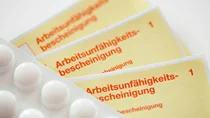

What is sickness benefit?
If a person is unable to work for health reasons, their employer will continue to pay their wages for a period of six weeks. This is known as sick pay or continued pay. The employer must be notified without delay of the individual’s inability to work and of how long this is likely to last.
In the case of people with statutory health insurance, the inability to work has been electronically reported to health insurance funds by medical practices (eAU) since January 1, 2023. Employers can access this information directly from the health insurance fund. It is usually no longer necessary to provide a paper copy to employers. Exceptions include minijobs in private households or if the inability to work has been determined through private medical treatment. People with private medical insurance must continue to submit their sick leave notice to their employer themselves.
If the person’s sick leave continues after a period of six weeks, sickness benefit legislation applies and the health insurance fund steps in. This applies at least to
- employees with statutory health insurance
- trainees
- self-employed people with voluntary health insurance, who have submitted an optional declaration (“Wahlerklärung”) to their insurance fund or agreed to pay for supplementary cover (“Wahltarif”)
- people in receipt of unemployment benefit 1 (“ALG I”)
People with private insurance must insure themselves against this eventuality.
What are the criteria for claiming sickness benefit?
If you are an employee with statutory health insurance and are unable to work for a period longer than six weeks for the same health-related reason, you will receive sickness benefit from your health insurance fund. If you are a new employee and do not receive continued wages (sick pay) from your employer for the first four weeks if you become ill, you will receive sickness benefit from your health insurance fund from the first day of your sick leave. If your incapacity for work extends beyond the first four weeks of your employment, your employer will resume paying your wages as of day 29. Sickness benefit is also paid to people who require in-house treatment for extended period – for example, in a hospital or rehabilitation center if this is covered by the health insurance fund.

The following criteria also apply to sickness benefit:
- The work the person does is subject to social insurance contributions. This means that their wages exceed the limit for “minijobs” (marginal employment) and contributions must be paid towards health insurance, long-term care insurance, unemployment insurance and pension insurance.
- The employment contract was concluded for at least ten weeks.
People in receipt of unemployment benefit 1 can also claim sickness benefit. People employed in “minijobs” (marginal employment), insured family members and self-employed individuals are not entitled to sickness benefit. However, if a person’s main source of income comes from their work as a self-employed individual, they have the option of insuring themselves with statutory health insurance. For this purpose, they are required to submit an optional declaration (“Wahlerklärung”) or agree to pay a rate for supplementary cover (“Wahltarif”). Students do not usually receive sickness benefit either.
People with private health insurance are required to pay for additional private insurance for daily sickness allowance to ensure that they are covered in the event of a lengthy illness. They do not receive statutory sickness benefit and a sickness benefit is not automatically included in their private health insurance.
More information about private sickness benefit insurance is provided (in German) on the website privat-patienten.de from the German Association of Private Health Insurers (Verband der Privaten Krankenversicherung).

Good to know: In the event of a work accident or occupational disease, you will not receive sickness benefit from your health insurance fund. Instead, a German accident insurance fund or employers’ liability insurance association will usually pay what is known as injury benefit.
Caring for a sick child – child sickness benefit
For those with statutory health insurance, it is possible to claim sickness benefit when caring for a sick child. This benefit is commonly known as child sickness benefit. This benefit is for parents who are unable to work because they have a sick child aged 12 or younger who is dependent on their care. This type of benefit can only be claimed if the employer does not continue to pay the person’s wages in the event of illness.
All parents covered by statutory health insurance have an annual entitlement to a maximum of 15 days payment of child sickness benefit per child. Single parents are entitled to up to 30 days per child. In the case of multiple children, the upper limit is 35 days per parent or 70 days for single parents. This rule currently applies until the end of 2026. When a child becomes ill, their parent can claim child sickness benefit if both the sick child and the parent caring for them have statutory health insurance.
To apply for child sickness benefit from the health insurance fund, a doctor’s cert is required from the first day of illness. This certifies that the sick child requires care.
For more information about child sickness benefit and leave from work, see the kindergesundheit-info.de web portal of the Federal Institute for Public Health (Bundesinstitut für Öffentliche Gesundheit – BIÖG).
What amount of sickness benefit is paid and for how long?
The amount of sickness benefit a person can claim is calculated on the basis of their regular income. The benefit amounts to 70 percent of gross salary subject to social insurance contributions but not more than 90 percent of net earnings. This rule prevents sickness benefit from exceeding regular net income. The law also stipulates a maximum amount for sickness benefit.
Additional payments such as vacation or Christmas bonuses are also included in the calculation. However, the calculation does not include non-contributory components of income, such as overtime pay for working nights or weekends.
Sickness benefit is paid for every calendar day on which the employee is on sick leave from work. It is always paid for 30 days in a full calendar month. Contributions towards pension insurance, unemployment insurance and long-term care insurance are deducted from sickness benefit.
As a result, the sickness benefit a person receives may be much less than their regular salary. They may find that money becomes tight if they are on sick leave for a lengthy period. If a person wants to make provision for this scenario, they can consider taking out a private insurance policy for a daily sickness allowance. However, only the difference between sickness benefit and actual net income can be insured. In other words, sickness benefit and daily sickness allowance together must not exceed the person’s lost net income.
For those with private insurance, the amount of daily sickness allowance they can claim depends on the individual terms and conditions of their insurance policy but cannot exceed their net income.
Duration of sickness benefit payments
A person with statutory health insurance can claim sickness benefit for the same health condition for a maximum of 78 weeks in a three-year period. It is irrelevant whether the sick leave is taken in a single block or in a number of separate blocks. This period begins on the first day of sick leave. The period during which the employer continues to pay wages (sick pay) while the employee is ill is included in the calculation. The calculation also includes rehabilitation measures. The duration is not extended if the person suffers an additional illness during the period in which sickness benefit is being paid for the original illness.

After sickness benefit
After a total of 78 weeks of entitlement to sickness benefit, the ideal scenario is that the person has recovered sufficiently to return to work. If you are able to return to work gradually after an illness, the Hamburg Model of gradual reintegration into the workplace slowly increases your working hours over an extended period. Sickness benefit is paid during this period. Note, however, that the reintegration period counts towards the total entitlement period of 78 weeks, which is not extended.
If you continue to be certified as unfit for work, it may be possible to claim unemployment benefit 1 (“ALG I”). This also applies if the person’s current employment relationship remains unchanged. If a person is permanently unable to work after the period of entitlement to sickness benefit, they can apply for a reduced earning capacity pension (“Erwerbsminderungsrente”).
In this case, advice can be sought from statutory pension funds. Members of social associations such as the VdK or SoVD can contact the advice centers operated by these associations.
What do I need to do to claim sickness benefit?
Your doctor will inform your health insurance fund about your incapacity for work directly by means of a digital data transfer. You will usually also receive a copy for your files; you do not have to submit this to your health insurance fund. Only on exceptions, such as technical faults or if you are privately insured, can it still be necessary to submit a paper copy.
Medical practices will send details of employees’ incapacity for work to health insurance funds, and employers will be able to check the details directly with health insurance funds. For this to be possible, you must immediately notify your employer of your incapacity for work and its expected duration.
Reports of rehabilitation or hospital treatment have also been largely electronic since January 01, 2025. If, however, the facility is not yet set up for the electronic procedure or another exception exists (e.g. in the case of people with private health insurance), a certificate of admission (known as a “Liegebescheinigung” in German) is still issued. This must be independently submitted to the health insurance fund.
The health insurance fund also requires proof of income in order to calculate sickness benefit. For this reason, the employer provides the insurance fund with a statement of earnings, specifying, for example, the period for which the employee will continue to receive payment from the employer while on sick leave (sick pay). The health insurance fund begins paying sickness benefit as of the next day. The employee is not required to submit a claim for sickness benefit. The health insurance fund will contact the employee if any further information is required. If you are asked to complete forms or provide other details in connection with your sickness benefit claim, you must comply with the request, provided that the details are relevant to the payment of sickness benefit. This is because people with statutory health insurance have a duty to cooperate.
If your sick leave notice expires, you are required to visit the doctor’s practice again by the next working day at the latest. If, for example, your sick cert expires on a Friday, you will require a new sick cert as of the following Monday.

Important: If you are sick for an uninterrupted period of time, it is important to ensure that you obtain a sick cert from your doctor to cover this entire period without any gaps. While you will not completely lose your entitlement to sickness benefit if there is a gap in your sick certs for a period of less than a month, you will not receive any sickness benefit for the days that are not covered by a sick note.
Please also note the following points:
- The subsequent sick cert must contain the same diagnosis as the original sick cert.
- The sick cert must be submitted to the health insurance fund within a period of one week of the start of the employee’s incapacity for work as diagnosed by their doctor. This happens automatically if the doctor’s practice transfers the certificate digitally.
What are my rights and obligations while in receipt of sickness benefit?
People on sick leave should not do anything to endanger their recovery. For example, anyone on sick leave due to back pain should not renovate their house. Walking or visiting a thermal spa, on the other hand, is permitted in such cases. It is also acceptable to take a holiday within the EU while in receipt of sickness benefit. However, unlike a holiday within Germany, this requires the prior approval of the insurance fund.
Working while in receipt of sickness benefit is not permitted. If a person is working, they are entitled to their regular wages but not to sickness benefit.
Verification of incapacity for work
If in doubt, the health insurance fund is entitled to check whether a person claiming sickness benefit is really unfit to work. They enlist the help of the Medical Review Board (“Medizinischer Dienst”, MD) for this purpose. It uses the medical documents available – and sometimes also conducts a physical examination – to compile an expert report. It is possible for the Medical Review Board to reach a conclusion that differs from that of the doctor who originally treated the patient. This means that, even if your doctor certifies that you are unfit for work, the Medical Review Board may determine that you are in fact fit for work. As a result, the health insurance fund may no longer pay sickness benefit.
If this happens, you are entitled to lodge an appeal. You are also entitled to receive a copy of the expert report. In any case, it is essential that you remain on sick leave. Otherwise, you will have no chance of your appeal being successful and receiving back-dated sickness benefit for this time. In addition, your doctor can provide the health insurance fund with a reason, in writing, why you continue to be unfit for work and ask for a second expert report to be undertaken.
Important: A health insurance fund cannot simply make a phone call to the insured party to check whether they are really unfit for work. If you have previously consented to the health insurance fund consulting with you over the phone, you can revoke this consent at any point and insist that all communication be in writing.
Request to submit a claim for rehabilitation
The expert report of the Medical Review Board may state that your capacity for work is compromised or reduced. In this case, the health insurance fund can request you to submit a claim for medical rehabilitation or “employment participation benefits” (“Leistungen zur Teilhabe”) to your pension insurance fund. If you fail to comply with this request within the specified period of ten weeks, your sickness benefit payments will be stopped.
The pension insurance fund will check your claim. They will assess whether the rehabilitation measure is likely to prevent a permanent reduction in earning capacity and therefore also the entitlement to a corresponding pension. If this is the case, your claim for rehabilitation will be approved. However, if the pension insurance fund concludes that medical rehabilitation is unlikely to be successful, your claim for medical rehabilitation will automatically be treated as a claim for a reduced earning capacity pension (“Erwerbsminderungsrente”). The same applies if the rehabilitation measure implemented does not demonstrate the degree of success it was expected to have.
You have the option of lodging an appeal against your health insurance fund’s request that you submit a claim of this type. You can also seek advice if you are unsure about how to proceed.
What is my first port of call for advice?
The rules regulating sickness benefit can sometimes be difficult to follow.
In the event of any legal uncertainties, individual questions or problems with sickness benefit, the Independent Patient Advice Service for Germany (UPD) is a source of useful advice and support.
Consumer advice centers and other social assistance advisory centers can also provide help with these issues. All of these bodies are potential points of contact if your sickness benefit claim is denied or your sickness benefit payments are stopped.
If you so wish, you are also entitled to access advice and support through your health insurance fund in relation to rehabilitation measures to restore your capacity to work. You must agree to this in writing. Health insurance funds are not permitted to use this advisory service as a means of putting pressure on policyholders who are unfit for work, e.g. by persuading them to take certain measures. No-one is obliged to avail of the advice available from health insurance funds. If you are unhappy in any way with the advisory services provided by the health insurance fund, you can withdraw your consent at any time.
- Bundesamt für soziale Sicherung. Gesetzeskonforme Umsetzung der Beratung und Hilfestellung nach § 44 Abs. 4 SGB V. 10.02.2021.
- Bundesministerium für Gesundheit. Krankengeld. Aufgerufen am 21.08.2025.
- Bundesministerium der Justiz. Sozialgesetzbuch (SGB) - Fünftes Buch (V) - Gesetzliche Krankenversicherung (Artikel 1 des Gesetzes v. 20. Dezember 1988, BGBl. I S. 2477). Stand: 25.02.2025.
- PKV Verband der Privaten Krankenversicherung e.V. Acht Punkte zum Krankentagegeld, die Sie kennen sollten. Aufgerufen am 21.08.2025.
- Stiftung Warentest. Krankengeld – Anspruch, Dauer, Höhe, Berechnung. 2021. 03.06.2025.
- Verbraucherzentrale. Krankengeld: Ab wann Sie es bekommen und wie Sie es beantragen. Stand: 09.05.2025.
- Verbraucherzentrale. Wer Krankengeld bekommt, darf dennoch Urlaub in der EU machen. Stand: 24.02.2025.

In cooperation with the Independent Patient Advice Service for Germany (Stiftung Unabhängige Patientenberatung Deutschland – UPD).
As at: