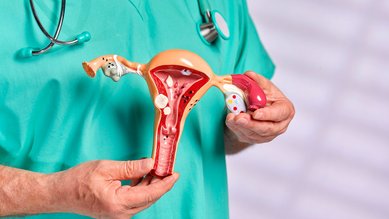
Conditions Vaginal prolapse and uterine prolapse
ICD codes: N81 What are ICD codes?
Various factors can cause a weakening of the connective tissue in the pelvic floor, causing the uterus, bladder or rectum to sag and drop downwards in the pelvis. This is known as a prolapse and can be treated with training exercises of the pelvic floor, therapeutic pessaries or surgery.
At a glance
- If the connective tissue in the pelvic floor is weakened, the womb (uterus), vagina, bladder, or rectum can sag.
- Among other things, this may lead to a feeling of pressure in the lower abdomen, bladder problems, and digestive issues.
- About half of all women experience a slight weakening of the pelvic floor over the course of their lives.
- An estimated 5 percent of all women have pelvic organ prolapse that causes distressing symptoms.
- Pelvic floor training and pessaries can relieve the symptoms.
- Sometimes, surgery to stabilize the pelvic organs is an option.
Note: The information in this article cannot and should not replace a medical consultation and must not be used for self-diagnosis or treatment.


Was is a vaginal prolapse and uterine prolapse?
Normally, the body’s internal organs are held so securely by connective tissue and muscles that they stay in place. However, the connective tissue in a woman’s pelvic floor can weaken for various reasons.
As a result, the uterus, urinary bladder, or rectum can prolapse. In some cases, the organs drop so far down in the pelvis that the vagina bulges through the vaginal opening or the uterus emerges from the vagina. Doctors refer to this as vaginal or uterine prolapse (genital prolapse). In summary, the term “pelvic floor descent” is also frequently used.
Bladder prolapse is the most common condition. The bladder presses downwards against the vagina. Since the connective tissue supports several organs, they frequently sag together. Prolapse is treated primarily through pelvic floor exercises (also known as Kegel exercises), silicone supports (pessaries) or surgery.
What are the symptoms of a vaginal prolapse and uterine prolapse?
Women who experience a mild weakening of the pelvic floor often do not have any symptoms at all. However, the following symptoms can occur if the organs prolapse further:
- feeling that something is pressing down
- foreign body sensation in the lower abdomen
- urinary incontinence, increased urinary urgency, or difficulty urinating
- pulling pain in the lower abdomen
- pain or problems during sexual intercourse
- difficulty with bowel movements
- back pain and lower back pain
- pressure sores and bleeding in the vagina
Pain, pressure, and foreign body sensations occur especially when standing, walking, or having a bowel movement. When lying down, these symptoms often subside.
Sometimes the organs descend so far that the vagina turns inside out or part of the womb (uterus) protrudes visibly from the vagina. Such a vaginal or uterine prolapse is usually particularly distressing – physically, but also emotionally.
Many affected women with severe prolapse experience feelings of shame. Sex life can also be severely affected.
What causes vaginal prolapse and uterine prolapse?
The pelvic floor closes off the pelvis at the bottom. It is made up of muscles and connective tissue and stabilizes the pelvic organs. Organ prolapse is caused by excessively weak muscles and weak connective tissue in the pelvic floor. Doctors refer to this as pelvic floor weakness (pelvic floor insufficiency). In some women, weaker connective tissue is hereditary.
Other factors are:
- Vaginal birth: this can weaken and damage the pelvic floor. If the delivery phase during childbirth lasts a long time, the risk of damage increases. The risk also increases if the baby weighs more than 4,000 grams at birth or is delivered using forceps or a vacuum extractor. The risk of vaginal and uterine prolapse is not increased following a cesarean section.
- Age: muscles and connective tissue weaken with age. This can make the support structures in the pelvic floor less stable.
- Weight: women who are very overweight (obese) are at an increased risk of a vaginal prolapse and uterine prolapse.
Pressure on the pelvic floor may also weaken the connective tissue, for example through heavy lifting and carrying, chronic coughing or frequent constipation. However, few studies on this have been conducted to date. It is therefore unclear what impact these types of stresses have.
It is also unclear whether removal of the uterus increases the risk of organ prolapse. However, it is suspected that the bowel and bladder have less support after a hysterectomy and descend more easily.
How common are vaginal prolapse and uterine prolapse?
About half of all women experience a slight weakening of the pelvic floor over the course of their lives, though usually without major symptoms. Approximately 5% of all women have organ prolapse that leads to distressing symptoms.

How do vaginal prolapse and uterine prolapse develop?
There are four different stages of vaginal and uterine prolapse. The stage depends on how far the bladder, uterus, vagina, or bowel have descended into the pelvis.
- Stage 1: the organs have prolapsed only slightly.
- Stage 2: the organs have prolapsed as far as the opening of the vagina.
- Stage 3: the vagina or uterus protrudes from the vaginal opening by up to 1 cm.
- Stage 4: a large part of the vagina or uterus protrudes from the vaginal opening.
In most cases, the prolapse is slight. This may even recede after a few months or years – for example, if it occurred after childbirth. However, a pelvic organ prolapse can also progress slowly.
About half of women with mild pelvic organ prolapse (stage 1 or 2) also have urinary incontinence. Doctors refer to this type of incontinence as stress incontinence. The reason is that the bladder can no longer withstand the pressure that occurs, for example, when coughing, sneezing or exercising, and releases some urine unintentionally.
In contrast, those with a stage 3 or 4 prolapse tend to have more difficulty emptying the bladder. This is because more severely prolapsed organs can cause the urethra to bend.
How can vaginal and uterine prolapse be prevented?
Regularly exercising the pelvic floor strengthens the pelvic muscles and the pelvic floor. After childbirth, postnatal exercises can strengthen the pelvic floor again. It is sometimes also recommended not to lift or carry heavy objects. This helps to relieve the pressure on the pelvic floor.
Pressure on the pelvic floor may be relieved by treating chronic cough and chronic constipation. However, there are insufficient studies to show whether these measures, or even weight loss, can actually prevent pelvic organ prolapse.
How are vaginal prolapse and uterine prolapse diagnosed?
Visits to a doctor are often prompted by general lower abdominal discomfort or bladder problems. Severe pelvic organ prolapse can be detected with a vaginal examination. Doctors can detect a mild prolapse by palpating the organs in the pelvis, from the outside and through the vagina.
In addition, the vagina is examined using a speculum. By palpating the bowel through the anus, doctors can assess the location of the organs in the back of the pelvis. These examinations are usually sufficient to detect a pelvic organ prolapse and determine its severity.
A cough stress test is used to determine if stress incontinence is present. This is the case if urine is passed when coughing vigorously.
If there are problems with urination, a post-void residual urine test can be performed. The patient first goes to the toilet and urinates to empty the bladder as much as possible. The doctor then uses an ultrasound device to check whether there is still urine in the bladder.
How are vaginal prolapse and uterine prolapse treated?
Treatment of vaginal prolapse and uterine prolapse largely depends on whether symptoms occur. The severity of the prolapse plays a secondary role.
Factors that determine which treatment is suitable include:
- which symptoms are expected to improve and how distressing they are
- the woman’s age
- whether the patient wants to have children in the future
- whether the patient wants to keep her uterus
- which organ has prolapsed and how far
- how well non-surgical treatments work
- whether urinary incontinence or other conditions are present

Treatment options for vaginal prolapse and uterine prolapse include:
- Pelvic floor exercises to strengthen the muscles
- Therapeutic pessaries: bowls, cubes, or rings of different sizes made of rubber or silicone are inserted into the vagina and are intended to support the organs in the pelvis. They should be individually fitted. These pessaries are not to be confused with pessaries used for contraception.
- Surgery: this involves lifting and stabilizing the organs in the pelvis and strengthening the connective tissue. In some cases, removal of the uterus (hysterectomy) is also considered.
Some women with a pelvic organ prolapse can sufficiently alleviate their symptoms with pelvic floor exercises or a therapeutic pessary. Hormonal treatments, such as vaginal creams, are sometimes also recommended. However, there is no evidence that they help with symptoms of pelvic organ prolapse. They can, however, protect the lining when a pessary is used, as well as make insertion easier.
If these treatments do not help, if the symptoms continue to worsen or if the uterus protrudes further from the vaginal opening, surgery may be an alternative. In general, the uterus remains intact after surgery.
The decision aid from gesundheitsinformation.de can help you choose an appropriate treatment for uterine prolapse.
- Barber MD. Pelvic organ prolapse. BMJ 2016; 354: i3853.
- Cattani L, Decoene J, Page AS et al. Pregnancy, labour and delivery as risk factors for pelvic organ prolapse: a systematic review. Int Urogynecol J 2021; 32(7): 1623-1631.
- Deutsche Gesellschaft für Gynäkologie und Geburtshilfe (DGGG). Weiblicher Descensus genitalis, Diagnostik und Therapie (S2e-Leitlinie, in Überarbeitung). AWMF-Registernr.: 015-006. 2015.
- Maher C, Yeung E, Haya N et al. Surgery for women with apical vaginal prolapse. Cochrane Database Syst Rev 2023; (7): CD012376.
- Samimi P, Jones SH, Giri A. Family history and pelvic organ prolapse: a systematic review and meta-analysis. Int Urogynecol J 2021; 32(4): 759-774.
- Sansone S, Sze C, Eidelberg A et al. Role of Pessaries in the Treatment of Pelvic Organ Prolapse: A Systematic Review and Meta-analysis. Obstet Gynecol 2022; 140(4): 613-622.
- Schulten SF, Claas-Quax MJ, Weemhoff M et al. Risk factors for primary pelvic organ prolapse and prolapse recurrence: an updated systematic review and meta-analysis. Am J Obstet Gynecol 2022; 227(2): 192-208.
- Taithongchai A, Johnson EE, Ismail SI et al. Oestrogen therapy for treating pelvic organ prolapse in postmenopausal women. Cochrane Database Syst Rev 2023; (7): CD014592.
- Toye F, Pearl J, Vincent K et al. A qualitative evidence synthesis using meta-ethnography to understand the experience of living with pelvic organ prolapse. Int Urogynecol J 2020; 31(12): 2631-2644.
- Tunn R, Baessler K, Knüpfer S et al. Urinary Incontinence and Pelvic Organ Prolapse in Women. Dtsch Arztebl Int 2023; 120(5): 71-80.
- Vergeldt TF, Weemhoff M, IntHout J et al. Risk factors for pelvic organ prolapse and its recurrence: a systematic review. Int Urogynecol J 2015; 26(11): 1559-1573.
- Wu YM, McInnes N, Leong Y. Pelvic Floor Muscle Training Versus Watchful Waiting and Pelvic Floor Disorders in Postpartum Women: A Systematic Review and Meta-analysis. Female Pelvic Med Reconstr Surg 2018; 24(2): 142-149.