Healthy living First aid for poisoning
Poisoning can be caused by various substances, such as cleaning agents, poisonous plants or drugs. The severity of the poisoning largely depends on the type and quantity of the substance involved.
At a glance
- Poisoning occurs when harmful substances enter the body through the mouth, nose, skin or eyes.
- The severity of the poisoning depends on the type and quantity of the poison involved, the duration of the exposure and the age and body weight of the person affected.
- If severe acute poisoning is suspected, the emergency services should be called immediately by dialing 112.
- For non-life-threatening poisoning, you can contact a poison control center.
- The person’s level of consciousness, breathing and heart rate must be monitored and – if necessary – measures must be taken to save their life.
- It is helpful to the treating doctors if any remnants of the poisonous substance or its packaging can be provided to them.
Note: The information in this article cannot and should not replace a medical consultation and must not be used for self-diagnosis or treatment.


What is meant by poisoning?
Poisoning occurs when harmful substances enter the body and cause damage to it. The poisonous substances may be ingested or absorbed through the mouth, nose, skin or eyes. Many different substances can cause poisoning. The severity of the outcome of poisoning depends on the type and quantity of the poison involved and the duration of the exposure. The age, body weight and overall health of the person affected are also important. Small quantities of certain poisons are harmless to adults. However, they may be fatal for children.
How is acute poisoning detected?
Poisoning can have a wide range of symptoms. These may occur immediately or after a delay.

The most common signs of poisoning include:
- abdominal pain and diarrhea
- nausea and vomiting
- headache and dizziness
- altered consciousness
- loss of consciousness
- excessively fast or slow pulse
- paleness
- shortness of breath
- flushed skin or skin rash
- visual impairment
- paralysis or seizures
- cardiac arrest
Urgent action is important if acute poisoning is suspected. In the event of life-threatening symptoms such as a sudden loss of breath, loss of consciousness or heart or respiratory failure, call the emergency service immediately by dialing 112. If poisoning is suspected but the symptoms are not life-threatening, you can call a poison control center.
For a complete overview of emergency phone numbers for poison control centers, see the website of the Federal Office of Consumer Protection and Food Safety (Bundesamt für Verbraucherschutz und Lebensmittelsicherheit, BVL).
What causes poisoning to occur?
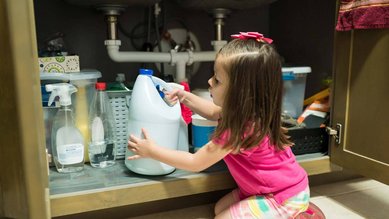
Most cases of poisoning occur in the home or garden. Poisoning is one of the most common causes of accidents among children of pre-school age. Small children are particularly at risk because they use their mouths to explore objects and may taste plant leaves or liquids that look interesting or smell good.

In older people, poisoning can occur as a result of mixing up or taking an overdose of their medication, as well as excessive alcohol consumption, ingestion of poisonous mushrooms or exposure to gases.
The following are hazard sources for poisoning:
- detergents and other household chemicals
- personal care products and cosmetics
- essential oils and lamp oils
- medication
- paints, varnishes, solvents
- plant protection products (pesticides)
- poisonous plants, berries, mushrooms
- spoiled food
- alcohol and illegal drugs
- gases
Important: The dose makes the poison. Substances that are not inherently poisonous – such as salt, for example – can cause fatal poisoning if they are consumed in large quantities.
What is the correct first aid response to poisoning?
If poisoning is suspected, it’s important to act quickly and to calm the affected person. The most important task is to preserve vital bodily functions and to mitigate the effects of the poison. If you observe a loss of consciousness, heart or respiratory failure or shortness of breath, call the emergency services and perform first aid. In the absence of acute, life-threatening symptoms, seek the advice of a poison control center.
What to do if someone swallows a foaming product
- In the event of life-threatening symptoms, call the emergency services. If you need advice, contact a poison control center.
- If any remaining product is still in the mouth, carefully remove it using a small amount of water.
- Do not have the person swallow any fluids, as this can increase the foaming.
- Give them a teaspoon of defoamer solution (if available) containing the active agent dimeticone or simeticone.
- As an alternative, fat may be beneficial, so have the person eat bread with plenty of butter.
- Only use activated carbon (charcoal) if advised to do so by the poison control center or emergency services.
What to do if someone swallows an acid or caustic substance
- Get them to drink one to two glasses of water or tea.
- Never induce vomiting.
- Also contact emergency services or a poison control center.
What to do if someone swallows an object that may cause chemical burns
Small children in particular frequently swallow button batteries (coin batteries). These contain small quantities of mercury oxide or silver oxide, zinc and an electrolyte solution. If these escape from the battery, they can cause chemical burns. If a child swallows a button battery:
- Call the emergency services.
- The child should be brought to hospital immediately.
- It is important for your child to have an X-ray to determine the location and condition of the battery. If the battery is located at the entrance to the esophagus, this can lead to life-threatening complications. The battery can be removed in hospital.
What to do if someone has eaten poisonous plants or mushrooms
- Remove any residue from the mouth.
- Wear protective gloves when doing so.
- Have the child or person affected drink half a glass of still water or tea.
- Keep the remains of the plant or mushroom that has been consumed (as vomited back up if necessary) to help identify the species.
- Contact a poison control center.
What to do if a person has taken medication by mistake or mixed up their medication
- Remove any remaining medication from the mouth.
- Give them tea, water or juice to drink.
- Keep the medication or package insert to hand.
- Contact a poison control center or, if the symptoms are life-threatening, phone emergency services.
What to do if a child has had alcohol or methanol to drink
Children don’t generally like the burning taste of high-strength alcohol or cosmetic products containing alcohol, which means that they seldom drink more than a sip. However, liquids with a high-methanol content can be fatal for small children or can lead to blindness. That’s why urgent action is important:
- Keep the child’s airways clear.
- In the event of life-threatening symptoms, call the emergency services. For non-life-threatening symptoms, contact a poison control center.
What to do if someone has suffered a chemical burn to their eye
- Immediately rinse the eye with lukewarm running water for 10 to 15 minutes.
- If there’s no tap nearby, use mineral water or press a wet cloth over the eyes.
- If necessary, get a second person to help by keeping the eyelid open.
- Protect the uninjured eye. When rinsing the eye, tilt the head so that the injured eye is lower than the uninjured eye, preventing the rinsing fluid from getting into the uninjured eye.
- Wear protective gloves if possible to avoid becoming burned yourself.
- Call emergency services on 112.
- After rinsing the injured eye, cover it with a sterile bandage.
What to do if someone’s skin has been chemically burned or damaged
- Remove any items of clothing that have come into contact with the poison and the injured skin.
- If possible, wear protective gloves when doing so.
- Thoroughly rinse and wash the skin with lukewarm water.
- Then dress the wounds with sterile bandaging if possible.
- Burns and chemical burns can lead to a risk of hypothermia so keep any uninjured parts of the body warm.
- Alert the emergency services.
What to do if someone has inhaled poisonous gas
- Give the person affected some fresh air – open the windows and doors.
- Protect yourself so that you don’t become exposed to the poison also.
- Consider any potential explosion hazards.
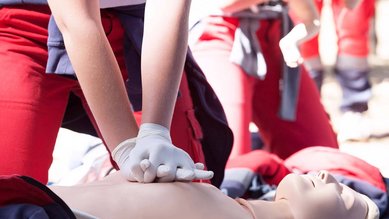
- If the person stops breathing, immediately begin chest compressions and mouth-to-mouth resuscitation and notify emergency services.
Which actions should be avoided in the event of poisoning?
If you suspect poisoning, it’s essential that you seek advice from emergency services or a poison control center. Many traditional home remedies have now been rendered obsolete and may even make matters worse.
All of the following measures should be avoided in the event of poisoning or if poisoning is suspected:
- Getting the person to drink milk – this actually helps the poison to be absorbed more quickly into the bloodstream.
- Giving the person a carbonated drink – this could trigger unwanted chemical reactions.
- Giving them salt water – this can cause salt poisoning, especially in small children.
- Inducing vomiting – this can lead to serious complications.
- Putting flour or oil on a burn or chemical burn – by doing so, you risk the wound becoming contaminated and infected.
It is important for anyone helping someone who has been poisoned to protect themselves and avoid close contact with the poison. It is helpful to wear protective gloves. If mouth-to-mouth resuscitation is required, wear a resuscitation mask.
Who to call when someone has been poisoned
If the person is showing clear signs of poisoning or life-threatening symptoms, call the emergency services first by dialing 112. If in any doubt about your suspicions, seek the advice of a poison control center.
There are seven regional poison control centers in Germany:
Berlin: Tel.: 030 / 19 240
Bonn: Tel.: 0228 / 19 240
Erfurt: Tel.: 0361 / 730 730
Freiburg: Tel.: 0761 / 19 240
Göttingen: Tel.: 0551 / 19 240
Mainz: Tel.: 06131 / 19 240
Munich: Tel.: 089 / 19 240
What questions do I need to answer when calling a poison control center?
- WHO is affected – how old is the person, how tall are they and how heavy (approximately)?
- WHAT substance was involved – name or describe the plant or product. If there is any left, keep it safe and also keep the packaging or package insert.
- HOW MUCH and WHEN?
- HOW was the person exposed to the substance – through swallowing, inhalation, skin contact or eye contact?
- WHAT reactions is it causing – coughing, vomiting, muscle twitches, altered consciousness, pain?
- WHAT has been done – has first aid already been administered? What other measures were taken?
- WHO is calling – what name and phone number are to be used for the call-back?
Important: Don’t hesitate to phone a poison control center. It’s better to call when it’s not necessary than to fail to call when it is.
What is the poison emergency app?
The Federal Institute for Risk Assessment (Bundesinstitut für Risikobewertung, BfR) provides an app (“Vergiftungsunfälle bei Kindern”) that offers tips for giving first aid to children in the event of poisoning. The relevant poison control center can be contacted directly from the app. The app is available free of charge for standard smartphone operating systems. Once the app is installed, it can be used without Internet access.
In addition to first aid guidance, it also provides:
- information about poisoning risks
- descriptions of the symptoms of poisoning
- tips for storage of hazardous products and medications
- Berufsverband der Kinder- und Jugendärzte e.V. Vergiftungen. Aufgerufen am 21.08.2025.
- Bundesinstitut für Risikobewertung. BfR-App: Vergiftungsunfälle bei Kindern. Aufgerufen am 21.08.2025.
- Bundesinstitut für Risikobewertung. Risiko Vergiftungsunfälle bei Kindern. Aufgerufen am 21.08.2025.
- Deutsche Gesetzliche Unfallversicherung e.V. DGUV. Handbuch zur Ersten Hilfe in Bildungs- und Betreuungseinrichtungen für Kinder. Stand März 2023.
- Giftinformationszentrum-Nord der Länder Bremen, Hamburg, Niedersachsen und Schleswig-Holstein (GIZ-Nord). Erste Hilfe bei Vergiftung. Aufgerufen am 21.08.2025.
- Larsen R. Akute Vergiftungen. Anästhesie und Intensivmedizin für die Fachpflege 978–986. 14 Jun. 2016, doi:10.1007/978-3-662-50444-4_69.
- Stiftung Gesundheitswissen. Was tun bei Vergiftungen? Aufgerufen am 21.08.2025.