Healthy living First aid – be brave and take action
In a case of cardiac arrest, rapid help is required because brain damage starts within just a few minutes. The emergency services rarely arrive on the scene this quickly. So, in cases like these, don’t hesitate to provide first aid!
At a glance
- The emergency services can be called by dialing 112 from a landline or cell phone.
- Someone who is unconscious but breathing by themselves should be put in the recovery position. Their breathing should be checked regularly (every 30 seconds).
- If the person stops breathing, they should be put on their back and given chest compressions immediately.
- If a defibrillator is nearby, it should be used, following the instructions on it.
- It is everyone’s duty to help as best they can in an emergency.
- Anyone who, in the heat of the moment, fails to take the correct first aid steps cannot be held responsible later.
Why provide first aid?
First aid is a subject that most people rarely encounter under normal circumstances. But when the situation calls for it, we need to stay calm and take the right action. The few minutes before the ambulance arrives can determine whether people who are sick or injured will live, die, or suffer long-term harm.
Anyone can find themselves in life-threatening situations, hoping that someone will help them. However, many of us feel overwhelmed in this type of situation and fail to provide first aid out of fear of doing something wrong. Tens of thousands of people die of a cardiac arrest every year in Germany. Only around 50 percent of first aiders immediately perform chest compressions. But it only takes 3 to 5 minutes without life-saving action before the person suffers severe brain damage. After 10 minutes, attempts at resuscitation are usually too late.
Important: Feeling uncertain shouldn’t stop you from helping. After all, a rib broken by chest compressions is of very little importance compared with brain damage. Anyone who, in the heat of the moment, fails to take the correct first aid steps cannot be held responsible later. However, the opposite is true if someone fails to act because we are all obliged to do what we can to help in the event of an emergency or an accident.
112: what happens when you call the emergency services?
The emergency services can be called by dialing 112, free of charge, from a landline or cell phone. This number is valid throughout Europe.

Calling the emergency services is usually the first part of the emergency chain, followed by first aid measures, until the ambulance can take over and get the sick or injured person to hospital.
What questions need to be answered when calling the emergency services?
- Where: when calling the emergency services, we need to give the exact location of the emergency, i.e. the town, street, building number, and, where relevant, the floor.
But don’t hang up then, as other issues need to be clarified:
- What has happened?
- How many sick or injured people are there?
- What are the injuries or illnesses, and do they appear to be life-threatening?
Interesting fact: The Nora emergency app makes emergency calls easier, and it can also be used by people with impaired speech or hearing. The app automatically sends your precise location to the relevant emergency control center. If you want, you can enter additional personal details for emergency personnel, such as a list of pre-existing health conditions.
How do you look after an unconscious person?
First, check whether the person is really unconscious. To do this, grip the person firmly by the shoulders and shake them gently. If they begin to respond, alert the emergency services if necessary.
If the person fails to respond and their eyes remain closed, they are unconscious.
In this case, it is useful for others to help, so call loudly for help and ask bystanders to alert the emergency services. If there is nobody around to help, you need to call 112 yourself.
Further action is required before the emergency services arrive.
- Check breathing: we can feel, and usually hear, breathing by putting our own cheek and ear close to the person’s mouth and nose. We can also watch to see whether their chest is moving. To check for breathing, the person’s head should be carefully tilted back: place one hand on the person’s forehead and the other under their chin, then slowly and gently tilt the head backwards so that the neck is extended. This needs to be done for around 10 seconds. Look for normal breathing – single, irregular, deep breaths or gasps are not signs of normal breathing and can occur in the early phase of a cardiac arrest.
- Recovery position: an unconscious person has no cough reflex and can suffocate on their own saliva, vomit or blood. If they are on their back, their tongue can also block their airways. For these reasons, someone who is unconscious but still breathing normally should be put in the recovery position. To do this, kneel beside the unconscious person. Position the arm closest to you at a right angle to their body. Take the person’s far arm and place the back of their hand against the cheek nearest to you. Then grasp their far leg above the knee and roll the person onto their side. The back of their hand supports the head, keeping it in position beneath the cheek, and their open mouth is the lowest point.
- To prevent them from getting cold, cover the person with a survival blanket and push it beneath their body too. The silver side should be facing the person’s body.
- Check their breathing at least once a minute until the emergency services arrive.
This video produced by the “Johanniter” emergency service explains how to put an unconscious person into the recovery position. For a detailed description, seegesundheitsinformation.de.
How should heavy bleeding be treated?
Heavy bleeding must be stopped, as the loss of even one liter of blood in adults can lead to shock.

How to proceed:
- First, put on some disposable gloves.
- Just elevating a bleeding arm or leg can reduce the bleeding.
- Press a clean cloth or the palm of your hand flat against the wound.
- Create a compression bandage using two bandage packs. Open the first pack and apply the dressing pad from this pack to the wound. Use the unopened second pack as a pressure pad, placing it on top of the dressing pad, and secure everything firmly in place with the bandage roll from the first pack.
- You need to call emergency services on 112 by this point at the latest.
The German Red Cross provides detailed information on its website about how to treat heavy bleeding.
What to do if the person has stopped breathing
If the person has stopped breathing or is only taking occasional gasps, it is important to begin giving chest compressions and rescue breaths as quickly as possible – if the brain fails to get oxygen for even a few minutes, lasting damage may be done.
Use a defibrillator if there is one nearby. There are automatic external defibrillators (AEDs) in stations, airports, some large venues, pharmacies and many other public places. These devices can be identified by their green label, showing a heart and an electric arrow. AEDs are specifically developed so that “anyone” can use them – they are easy to use and can detect a cardiac arrest automatically. The device has an integrated voice feature to issue instructions on what to do. A small screen or graphics provide further help.

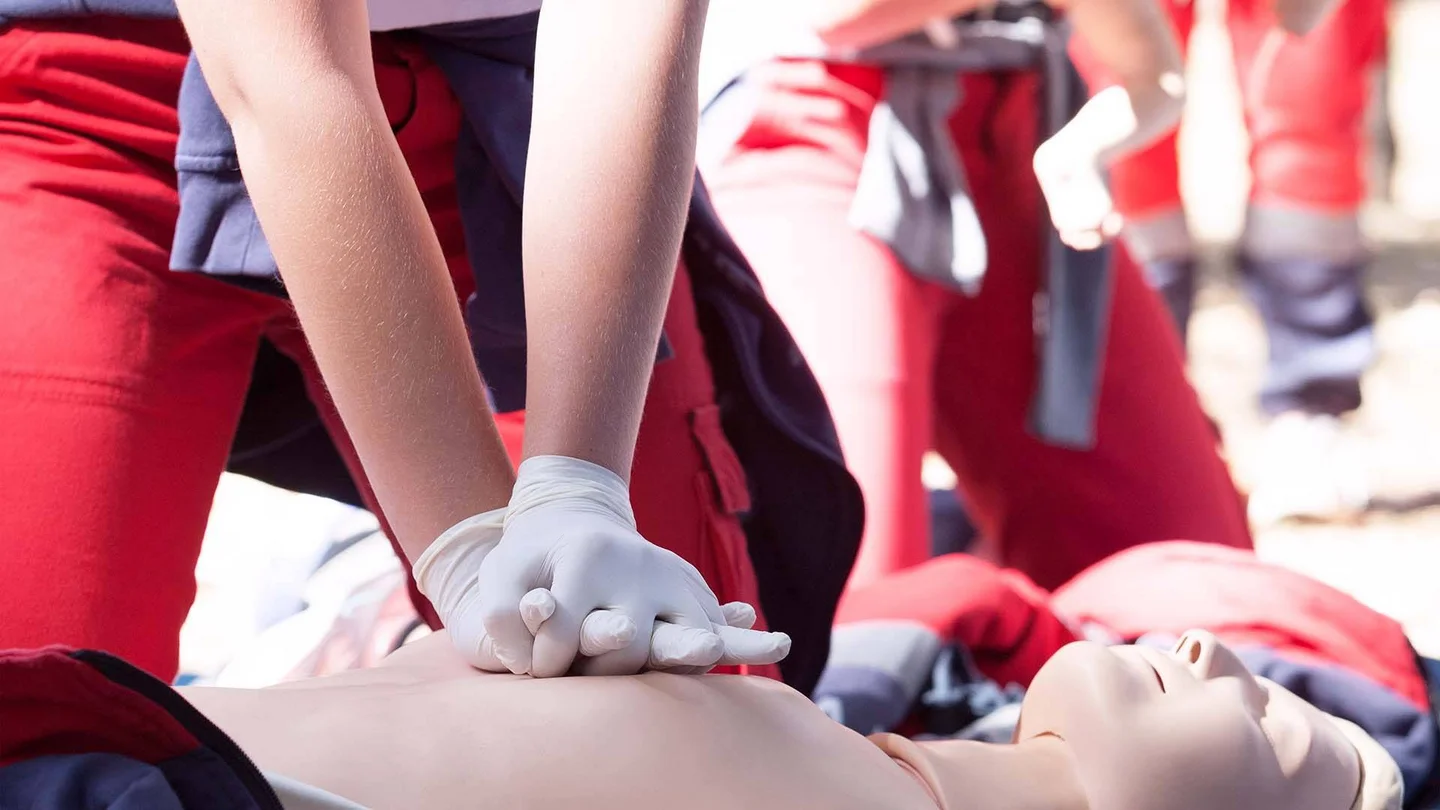
Until the defibrillator is used or if none is available, chest compressions should be performed.
- For this purpose, the person needs to be on their back on a hard surface.
- Put the heel of your hand in the middle of their chest on the sternum (breastbone), and support it with your other hand.
- Then give 30 chest compressions, at a rate of almost 2 per second. These involve pressing the chest down around 5 to 6 centimeters.
- Follow that with two rapid rescue breaths. To do this, tilt their head back slightly, pinch their nose, and breathe evenly from mouth to mouth (or mouth to nose) for about 1 second.
- Repeat chest compressions and rescue breaths until the emergency services arrive.
If several people are present, they should take turns performing chest compressions, as this is physically very demanding and the quality of chest compressions begins to decline after just one or two minutes.
If you have called the emergency services by dialing 112, the emergency call handler can guide you through the chest compressions over the phone.
The “Johanniter” emergency service has produced this video explaining how cardiopulmonary resuscitation (CPR) is done.
Road traffic accidents – key points
When there is an accident, the site first needs to be made safe. It is important to keep yourself safe, to stay calm, and to get an overview of the situation.
To avoid endangering yourself, you should:
- put on a high-visibility jacket
- put on the vehicle’s hazard lights
- put up a warning triangle at least 100 meters away
If other people are around, ask them to help by calling the emergency services and helping you with first aid.
After making the site of the accident secure, all injured people should be removed from the danger area if possible, particularly if there is a risk of fire.
Important: When people are conscious after an accident, they are often very distressed. It’s important to build trust by making eye contact with them and telling them your name. Ask whether the person is upset, cold, in pain or injured. Cautiously make physical contact, and always explain what you are intending to do.
Saving someone from a vehicle that has been in an accident:
- Release their safety belt or cut through it if necessary.
- If their feet are not jammed, the person can be taken out of the vehicle using the rescue maneuver.
- To do this, gently tilt the person forwards.
- From behind, put your arms beneath the person’s armpits, and grasp one of their lower arms, placing it horizontally across their chest.
- Pull the injured person onto your own thigh and drag them backwards out of the danger area.
- A second helper can take the weight of the injured person’s legs. A survival blanket, with its silver side towards the injured person, helps prevent them from getting cold.
Important: When doing the rescue maneuver, don’t fold your own arms around and under the injured person’s lower arm – instead, hook all your fingers (and thumbs) over from above. This way, you avoid compressing the arm too tightly.
Anybody lying down can be removed from a danger area in a similar way – after talking to them and explaining your intention, approach them from behind and grip them below their neck and shoulders. The head is thus supported by the lower arms. If the person has been put into a sitting position, they can be pulled away from the danger area using the rescue maneuver. The rescue maneuver is often also called the Rautek maneuver.
If a motorcyclist has had an accident and is unconscious, their helmet should be very carefully removed because there is a serious risk that they could suffocate. This is best done by two people. To do so, first open the visor and chin strap, and remove any goggles. One first aider grips the head on both sides with their thumbs in front of and the other fingers behind the ears. The other first aider kneels above the injured person and carefully removes the helmet. Abrupt head movements must be avoided.
The “Johanniter” emergency service has produced videos demonstrating how to use the rescue maneuver and how to remove a helmet correctly in the event of an accident.
How to prepare for emergency situations
Anyone who wants to get a driving license has to attend a first aid course. But how long ago was it that you completed yours, and can you still remember what to do in case of doubt? If not, it helps to repeat what you have learned. Because someone who feels confident can respond better and stay calm more easily if something serious occurs.
But first aid cannot be learned through theory alone. To really be able to help in a crisis, you need to attend a first aid course. First aid “refresher” courses are also recommended.
It is a good idea to keep a first aid box in the car and another at home. Note that its contents will have an expiry date, which should be checked regularly.
Important: There are specific courses on first aid for babies and children, aimed at parents, grandparents, pre-school teachers, childcare workers and anyone who works with children. No prior knowledge is required.
Where are first aid courses offered?
The organizations below are some of those that provide first aid courses and also education for workplace first responders:
- Deutsche Gesetzliche Unfallversicherung (DGUV). Information 204-006: Anleitung zur Ersten Hilfe. Januar 2023.
- Deutsches Reanimationsregister. Öffentlicher Jahresbericht 2023 des Deutschen Reanimationsregisters: Cardiac Arrest Center 2023. 2024.
- Riva G et al. Survival in Out-of-Hospital Cardiac Arrest After Standard Cardiopulmonary Resuscitation or Chest Compressions Only Before Arrival of Emergency Medical Services: Nationwide Study During Three Guideline Periods. Circulation. 2019 Jun 4;139(23):2600-2609.
- European Resuscitation Council. Guidelines 2021. First Aid. Resuscitation 2021, 161: 270.290.