Conditions Osteoarthritis of the knee (gonarthrosis)
ICD codes: M17 What are ICD codes?
Osteoarthritis of the knee typically begins with knee pain that initially only occurs with strain. If the osteoarthritis is advanced and cannot be sufficiently relieved with exercise and pain medication, a joint replacement may be considered.
At a glance
- In osteoarthritis of the knee, the protective cartilage layer in the joint becomes thinner.
- This leads to pain and restricted movement.
- Targeted exercise, non-steroidal anti-inflammatory drugs (NSAIDs), and weight loss if you are overweight can help.
- The common notion of it being necessary to go easy on the knee joints during osteoarthritis is false.
- Cortisone injections can relieve symptoms for a few weeks. But in the long run, they damage the cartilage.
- No effect has been demonstrated for other joint injections.
- A joint replacement is an option for advanced osteoarthritis and severe pain.
Note: The information in this article cannot and should not replace a medical consultation and must not be used for self-diagnosis or treatment.


What is osteoarthritis of the knee?
If the knee initially feels stiff after rests and hurts during movement, osteoarthritis may be behind it. Osteoarthritis of the knee (also known as knee arthrosis, knee arthritis or gonarthrosis) occurs when the articular cartilage in the knee becomes thinner and therefore provides less protection for the knee.
The widespread notion that you should rest your knee joints when you have osteoarthritis is incorrect. In fact, the opposite is true – physical activity strengthens the muscles that stabilize and protect the joints. Movement also ensures that the joint cartilage is supplied with nutrients. The primary treatments are therefore forms of exercise and physiotherapy that keep the cartilage and joints healthy and functional. For those who are overweight, losing a little weight can relieve strain on the knee.
Non-steroidal anti-inflammatory drugs (NSAIDs) can provide relief, especially during phases of more severe symptoms or during an acute flare-up. If knee osteoarthritis is already advanced, it can severely impair daily life and quality of life. If physical activity or painkillers are not enough to relieve symptoms, a joint replacement may be an option.

Important: There are many remedies and methods that are advertised as treatments for osteoarthritis even though their effectiveness is not proven and they may even do more harm than good.
What are the symptoms of osteoarthritis of the knee?
Osteoarthritis of the knee typically begins with knee pain that initially only occurs with strain. If the osteoarthritis progresses over time, the pain becomes more frequent and severe. It can then also occur during rest or at night and disturb the sleep. Furthermore, other symptoms like stiff joints can appear. Many people with osteoarthritis of the knee suffer joint pain, especially towards evening or in the morning.
Depending on which part of it is affected, pain can occur on the inside or outside of the knee. If the area under the kneecap is affected, pain occurs in particular when standing up and climbing stairs.

In the case of severe osteoarthritis, the pain occurs even during rest. It then often feels more nagging and can be temporarily very severe, lead to exhaustion and seriously limit everyday life.
The knee joint can also become stiffer and sensitive to pressure. If it is moved less, that weakens the muscles and ligaments. This can make the knee feel unstable.
For some people, osteoarthritis triggers acute flare-ups that can last several days. During these episodes, the pain suddenly becomes more intense and may feel like shooting, pulsing or burning in the knee. The knee may also temporarily swell up, become stiffer and feel hot. Acute episodes can be particularly aggravating because they are difficult to predict.
What are the causes of osteoarthritis of the knee?
The knee joint connects the femur and lower leg bones and the kneecap. The epiphyses and inside of the kneecap are covered with cartilage. A healthy cartilage is a smooth sliding surface that makes low-friction movement in the joint possible. Osteoarthritis develops when the cartilage softens, disintegrates and thins.
Osteoarthritis of the knee can occur in three areas of the knee:
- on the inside of the knee joint (medial)
- on the outside of the knee joint (lateral)
- under the kneecap (patellofemoral)
Colloquially, osteoarthritis is often referred to as “joint wear and tear”. However, this phrase is misleading as it gives the impression that osteoarthritis is unstoppable and the joints are “worn down” through normal use. This is not the case at all. In fact, cartilage in the joints is naturally broken down and rebuilt all the time.
The joint requires movement to promote regenerative processes. This ensures that the knee receives enough blood flow. Cartilage also relies on movement: much like a sponge, it squeezes out waste products when under pressure and absorbs fresh nutrients from the joint fluid when the pressure is released. Targeted exercise and activities like walking or cycling are therefore good for your cartilage and joints, even if you have osteoarthritis.
Video What causes osteoarthritis?
The video below explains how osteoarthritis develops and what causes it.
This and other videos can also be found on YouTube
Watch nowThe privacy policy indicated there applies.
What factors increase the risk of osteoarthritis of the knee?
The following factors increase the risk of osteoarthritis of the knee:
- Knee joint injuries: for example, due to meniscal damage, a tear in the anterior cruciate ligament, a dislocation of the patella or a bone fracture close to the knee joint
- Severe overweight (obesity): people who have a body-mass index (BMI) over 30 are considered obese. The higher the BMI, the greater the strain on the joints.
- Frequent severe strain on the knee: for example, people who frequently have to kneel, squat, or lift heavy loads as part of their job have a higher risk of osteoarthritis.
- Anatomy: for example, legs of differing length or defective knee positions (knock knees or bow legs)

Important: Some people think that movement puts additional strain on the knee joints, causing “wear and tear”. But a lack of exercise is in fact more harmful to joints. On one hand, it weakens the muscles. On the other, the articular cartilage depends on exercise. The varying pressure that acts on the cartilage during walking for instance ensures fluid replacement and nourishes the cartilage.
How common is osteoarthritis of the knee?
An estimated 4 percent of all adults in Germany have osteoarthritis of the knee. It becomes more common from around the age of 40.
How does osteoarthritis of the knee develop?
Osteoarthritis does not invariably mean that the knee is so damaged at one time or another that a joint replacement is required. Many people manage well in day-to-day life on a long-term basis, despite the symptoms.
The progression of osteoarthritis of the knee cannot be predicted with certainty. Many people only have minor discomfort for many years, while for others the osteoarthritis advances more quickly. Sometimes the symptoms even subside over time.
A comprehensive analysis of studies with over 7000 participants showed the following course over 5 to 8 years:
- In about 85 percent of cases, the pain remained roughly the same.
- In about 7 percent of cases, the pain increased.
- In about 8 percent of cases, the pain subsided.
Even though osteoarthritis of the knee usually progresses slowly and often remains relatively stable for years, symptoms still flare up for a few days or weeks from time to time.
About 40 percent of all people with osteoarthritis experience acute flare-ups, especially if they have had osteoarthritis for a long time. Most people have a flare-up about once a month. However, the frequency of flare-ups varies greatly.
Important: With very severely advanced osteoarthritis, the cartilage can be so worn away in places that the bone is exposed. Damage to the meniscus, weaker muscles and loosened ligaments are further possible consequences of advanced osteoarthritis of the knee. Additional joint fluid may also form and accumulate within the joint (joint effusion), which may similarly cause pain.
How is osteoarthritis of the knee diagnosed?
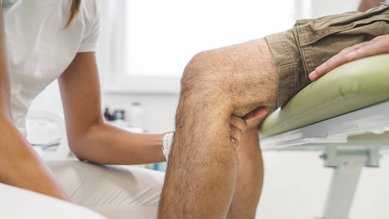
To determine osteoarthritis of the knee, the doctor asks about symptoms such as recurrent or persistent pain and temporary stiffness in the knee. They will check the range of motion of the knee joint, examine the leg position, palpate the knee and the joint space and examine the musculature.
Imaging examinations such as X-rays, ultrasound, or magnetic resonance imaging (MRI) reveal little about the symptoms in cases of osteoarthritis. For example, there are people with significant joint changes who experience hardly any symptoms, and others with severe symptoms whose joints look healthy.
Studies show that even people with no visible changes to the knee have the following:
- Meniscus tears or damage are visible on MRI scans in approximately 20 percent of people over the age of 40.
- Cartilage is altered in approximately 40 percent.
- Approximately 40 percent have osteophytes or bone changes.
If such changes are mistakenly blamed for the knee problems, this can trigger unnecessary fears and lead to unsuccessful operations. In any case, the treatment should be based on the symptoms and the individual situation, not on what can be seen in the X-ray images.
Imaging studies or blood tests are useful if another condition is suspected, such as rheumatoid arthritis or gout – or if a bone fracture needs to be ruled out following a fall or accident. Images of the knee joint are also taken before an artificial joint (joint replacement) is implanted to plan the operation.
How is osteoarthritis of the knee treated?
There are various options for treating osteoarthritis of the knee. Which ones are considered depends, for example, on how far advanced the osteoarthritis is, whether there are any accompanying conditions and what is expected from the treatment.
Staying active in spite of osteoarthritis is good for the joints. Many studies have demonstrated how regular strengthening and flexibility exercises relieve pain and can improve joint function. Yoga and Tai Chi are also an option.
For those who are overweight, losing weight can relieve strain on the joints. As studies have shown, a weight reduction of more than 5% can improve mobility and relieve joint pain to some degree. In concrete terms, this means that for a body weight of 100 kilograms, at least 5 kilograms needs to be lost.
You can also try well-fitting shoes with cushioned soles that support the arch of the foot. The shoes should also provide enough room for the toes. On the other hand, shoes with thin, flexible soles, such as barefoot shoes, and high heels should be avoided.

You can find more detailed information, for example about how to strengthen your knees, at gesundheitsinformation.de.
There are moreover numerous treatment approaches for osteoarthritis of the knee:
- Arch supports, orthoses (devices worn to support the knee joints) and offloading shoes are low-risk options to try. However, the effectiveness of shoe insoles and orthoses has not yet been well researched. Offloading shoes proved useful in a meaningful study, but were no more effective than normal, well-fitting and shock-absorbing shoes.
- Ointments or gels containing non-steroidal anti-inflammatory drugs (NSAIDs) such as diclofenac for application to the joint: They can relive osteoarthritis pain in some people and are a simple treatment option with few side effects.
- Non-steroidal anti-inflammatory drugs for ingestion like diclofenac, ibuprofen and etoricoxib can also demonstrably relieve osteoarthritic pain. Paracetamol is not effective with osteoarthritis of the knee.
- Opioid painkillers are often no more effective than anti-inflammatory drugs. They also have more side effects and can be addictive.
- Acupuncture: studies indicate that it can alleviate osteoarthritis of the knee – however not better than a so-called fake acupuncture in which the needles are only placed superficially or at the “wrong” site. Acupuncture for knee osteoarthritis is reimbursed by statutory health insurance funds.
- Injections into the joint: cortisone injections can relieve symptoms for up to 8 weeks but can cause damage to the cartilage in the long term with repeated use. There is no evidence that injections of your own blood (platelet-rich plasma) or stem cells are effective. Likewise, it could not be shown that hyaluronic acid injections help – on the contrary, they can even cause harm.
- A joint replacement may be considered in the case of advanced osteoarthritis of the knee. An artificial knee joint (prosthesis) significantly relieves the symptoms of advanced osteoarthritis of the knee for most people. After the operation, active rehabilitation is important, as well as patience while adjusting to the new knee.
- A corrective knee osteotomy is sometimes considered as an alternative to knee replacement. This surgical procedure involves correcting unevenness in the cartilage on one side of the knee.
Many other products and therapies with no benefit are also offered for the treatment of osteoarthritis of the knee, including:
- duloxetine
- herbal preparations like rampion or boswellia
- food supplements with chondroitin or glucosamine
- foods or food extracts, e.g. based on soybean, avocado or curcumin
- ultrasound therapies
- transcutaneous electric nerve stimulation (TENS)
- leech therapy
- psychological interventions
- whole-body vibration
- high-frequency therapy
- magnetic field therapy
- microwave therapy
- low-dose X-ray irradiation (also: orthovoltage therapy)
- radiosynoviorthesis (RSO)
- endoscopic knee irrigation and cartilage shaving (arthroscopy)

Important: If insertion of an artificial knee joint is planned, it is advisable to get an independent second medical opinion beforehand.
The decision aid from gesundheitsinformation.de can help you decide for or against a joint replacement.
- Bannuru RR, Osani MC, Vaysbrot EE et al. OARSI guidelines for the non-surgical management of knee, hip, and polyarticular osteoarthritis. Osteoarthritis Cartilage 2019; 27(11): 1578-1589.
- Bennell KL, Hunter DJ, Hinman RS. Management of osteoarthritis of the knee. BMJ 2012; 345: e4934.
- Costa LA, Lenza M, Irrgang JJ et al. How Does Platelet-Rich Plasma Compare Clinically to Other Therapies in the Treatment of Knee Osteoarthritis? A Systematic Review and Meta-analysis. Am J Sports Med 2023; 51(4): 1074-1086.
- Culvenor AG, Øiestad BE, Hart HF et al. Prevalence of knee osteoarthritis features on magnetic resonance imaging in asymptomatic uninjured adults: a systematic review and meta-analysis. Br J Sports Med 2019; 53(20): 1268-1278.
- Da Costa BR, Reichenbach S, Keller N et al. Effectiveness of non-steroidal anti-inflammatory drugs for the treatment of pain in knee and hip osteoarthritis: a network meta-analysis. Lancet 2017; 390(10090): e21-e33.
- Deng ZH, Zeng C, Yang Y et al. Topical diclofenac therapy for osteoarthritis: a meta-analysis of randomized controlled trials. Clin Rheumatol 2016; 35(5): 1253-1261.
- Derry S, Conaghan P, Da Silva JA et al. Topical NSAIDs for chronic musculoskeletal pain in adults. Cochrane Database Syst Rev 2016; (4): CD007400.
- Duivenvoorden T, Brouwer RW, van Raaij TM et al. Braces and orthoses for treating osteoarthritis of the knee. Cochrane Database Syst Rev 2015; (3): CD004020.
- Fransen M, McConnell S, Harmer AR et al. Exercise for osteoarthritis of the knee. Cochrane Database Syst Rev 2015; (1): CD004376.
- French HP, Abbott JH, Galvin R. Adjunctive therapies in addition to land-based exercise therapy for osteoarthritis of the hip or knee. Cochrane Database Syst Rev 2022; (10): CD011915.
- Hinman RS, Wrigley TV, Metcalf BR et al. Unloading Shoes for Self-management of Knee Osteoarthritis: A Randomized Trial. Ann Intern Med 2016; 165(6): 381-389.
- Hu L, Wang Y, Liu X et al. Tai Chi exercise can ameliorate physical and mental health of patients with knee osteoarthritis: systematic review and meta-analysis. Clin Rehabil 2021; 35(1): 64-79.
- Hurley M, Dickson K, Hallett R et al. Exercise interventions and patient beliefs for people with hip, knee or hip and knee osteoarthritis: a mixed methods review. Cochrane Database Syst Rev 2018; (4): CD010842.
- Jüni P, Hari R, Rutjes AW et al. Intra-articular corticosteroid for knee osteoarthritis. Cochrane Database Syst Rev 2015; (10): CD005328.
- Kim SH, Djaja YP, Park YB et al. Intra-articular Injection of Culture-Expanded Mesenchymal Stem Cells Without Adjuvant Surgery in Knee Osteoarthritis: A Systematic Review and Meta-analysis. Am J Sports Med 2020; 48(11): 2839-2849.
- Kim SH, Ha CW, Park YB et al. Intra-articular injection of mesenchymal stem cells for clinical outcomes and cartilage repair in osteoarthritis of the knee: a meta-analysis of randomized controlled trials. Arch Orthop Trauma Surg 2019; 139(7): 971-980.
- Kolasinski SL, Neogi T, Hochberg MC et al. 2019 American College of Rheumatology/Arthritis Foundation Guideline for the Management of Osteoarthritis of the Hand, Hip, and Knee. Arthritis Rheumatol 2020; 72(2): 220-233.
- Lauche R, Hunter DJ, Adams J, Cramer H. Yoga for Osteoarthritis: a Systematic Review and Meta-analysis. Curr Rheumatol Rep 2019; 21(9): 47.
- Liu X, Machado GC, Eyles JP et al. Dietary supplements for treating osteoarthritis: a systematic review and meta-analysis. Br J Sports Med 2018; 52(3): 167-175.
- Manyanga T, Froese M, Zarychanski R et al. Pain management with acupuncture in osteoarthritis: a systematic review and meta-analysis. BMC Altern Med 2014; 14: 312.
- McAlindon TE, LaValley MP, Harvey WF et al. Effect of Intra-articular Triamcinolone vs Saline on Knee Cartilage Volume and Pain in Patients With Knee Osteoarthritis: A Randomized Clinical Trial. JAMA 2017; 317(19): 1967-1975.
- Newberry SJ, FitzGerald J, SooHoo NF et al. Treatment of osteoarthritis of the knee: an update review. National Institute for Health Research (NHS; AHRQ Comparative Effectiveness Reviews No.190). 2017.
- Pereira TV, Juni P, Saadat P et al. Viscosupplementation for knee osteoarthritis: systematic review and meta-analysis. BMJ 2022; 378: e069722.
- Previtali D, Andriolo L, Di Laura Frattura G et al. Pain Trajectories in Knee Osteoarthritis-A Systematic Review and Best Evidence Synthesis on Pain Predictors. J Clin Med 2020; 9(9): 2828.
- Robson EK, Hodder RK, Kamper SJ et al. Effectiveness of Weight-Loss Interventions for Reducing Pain and Disability in People With Common Musculoskeletal Disorders: A Systematic Review With Meta-Analysis. J Orthop Sports Phys Ther 2020; 50(6): 319-333.
- Runhaar J, Rozendaal RM, Middelkoop MV et al. Subgroup analyses of the effectiveness of oral glucosamine for knee and hip osteoarthritis: a systematic review and individual patient data meta-analysis from the OA trail bank. Ann Rheum Dis 2017; 76(11): 1862-1869.
- Rutjes AW, Jüni P, da Costa BR et al. Viscosupplementation for osteoarthritis of the knee: a systematic review and meta-analysis. Ann Intern Med 2012; 157(3): 180-191.
- Sakellariou G, Conaghan PG, Zhang W et al. EULAR recommendations for the use of imaging in the clinical management of peripheral joint osteoarthritis. Ann Rheum Dis 2017; 76(9): 1484-1494.
- Saltychev M, Mattie R, McCormick Z, Laimi K. The Magnitude and Duration of the Effect of Intra-articular Corticosteroid Injections on Pain Severity in Knee Osteoarthritis: A Systematic Review and Meta-Analysis. Am J Phys Med Rehabil 2020; 99(7): 617-625.
- Scharf HP, Mansmann U, Streitberger K et al. Acupuncture and knee osteoarthritis: a three-armed randomized trial. Ann Intern Med 2006; 145(1): 12-20.
- Schmidt CO, Günther KP, Goronzy J et al. Häufigkeiten muskuloskelettaler Symptome und Erkrankungen in der bevölkerungsbezogenen NAKO Gesundheitsstudie [Frequencies of musculoskeletal symptoms and disorders in the population-based German National Cohort (GNC)]. Bundesgesundheitsblatt Gesundheitsforschung Gesundheitsschutz 2020; 63(4): 415-425.
- Si J, Sun L, Li Z et al. Effectiveness of home-based exercise interventions on pain, physical function and quality of life in individuals with knee osteoarthritis: a systematic review and meta-analysis. J Orthop Surg Res 2023; 18(1): 503.
- Ton J, Perry D, Thomas B et al. PEER umbrella systematic review of systematic reviews: Management of osteoarthritis in primary care. Can Fam Physician 2020; 66(3): e89-e98.
- Zeng C, Wei J, Persson MSM et al. Relative efficacy and safety of topical non-steroidal anti-inflammatory drugs for osteoarthritis: a systematic review and network meta-analysis of randomised controlled trials and observational studies. Br J Sports Med 2018; 52(10): 642-650.
- Zhang B, Yu X, Liang L et al. Is the Wedged Insole an Effective Treatment Option When Compared with a Flat (Placebo) Insole: A Systematic Review and Meta-Analysis. Evid Based Complement Alternat Med 2018: 8654107.
- Zhang J, Wang Q, Zhang C. Ineffectiveness of lateral-wedge insoles on the improvement of pain and function for medial knee osteoarthritis: a meta-analysis of controlled randomized trials. Arch Orthop Trauma Surg 2018; 138(10): 1453-1462.