Conditions Hip osteoarthritis (coxarthrosis)
ICD codes: M16 What are ICD codes?
Osteoarthritis of the hip often causes pain in the hip and groin area as well as stiffness or reduced movement. In osteoarthritis of the hip, the protective cartilage layer of the bones in the hip joint becomes thinner. Hip osteoarthritis mainly affects people over the age of 45.
At a glance
- Osteoarthritis of the hip usually begins gradually.
- This causes pain and restricts mobility.
- Above all, it is important to exercise regularly – and, in cases of severe obesity, to lose weight if possible.
- Painkillers can help during periods of more severe symptoms.
- If osteoarthritis is advanced, the hip is very painful, and other treatments do not provide enough relief, a joint replacement is an option.
Note: The information in this article cannot and should not replace a medical consultation and must not be used for self-diagnosis or treatment.

What is osteoarthritis of the hip?
In osteoarthritis of the hip, the protective cartilage layer of the bones in the hip joint becomes thinner. This leads to increasing pressure on the bones and gradually reduces the mobility of the joint. Pain in the hip and groin area, such as when walking or climbing the stairs, are often the first signs. Osteoarthritis of the hip can occur in one or both hip joints. Most people with osteoarthritis of the hip are over the age of 45.
How osteoarthritis of the hip develops varies considerably. Over time, many people experience only mild symptoms that have little or no effect on them. In some cases, however, the condition advances rapidly and can have a major impact on quality of life.
Exercise and physiotherapy are two of the main measures used to treat osteoarthritis of the hip. People can also take non-steroidal anti-inflammatory drugs (NSAIDs) and lose weight if they are very overweight.
If osteoarthritis of the hip progresses and severely restricts everyday life, an artificial hip joint (total hip arthroplasty) can be considered.
What are the symptoms of osteoarthritis of the hip?
Hip osteoarthritis usually begins insidiously – over several months, often even years. Initially, the pain often only occurs during exertion or at the end of a tiring day.
People with osteoarthritis of the hip often report pain in the hip joint and groin area when climbing stairs, walking or moving their thigh, for example, when crossing their legs. For some, the pain extends as far as the inner thigh, the buttocks or knee.
If hip osteoarthritis alters the bones and deforms the femoral head, mobility may be limited. This makes putting on tights or foot care more difficult. The more advanced the osteoarthritis becomes, the more it can limit everyday life, including work, housework, and hobbies. For people with osteoarthritis of the hip, these consequences for daily life are often the greatest burden.
The hip joint may feel slightly stiff for up to 30 minutes in the morning or after prolonged periods of rest. More prolonged morning stiffness is more likely to be a different condition such as rheumatoid arthritis. If the hips are in pain even when the person is at rest or during the night, the osteoarthritis has usually already reached an advanced stage.
Video What causes osteoarthritis?
The video below explains how osteoarthritis develops and what causes it.
This and other videos can also be found on YouTube
Watch nowThe privacy policy indicated there applies.
What causes osteoarthritis of the hip?
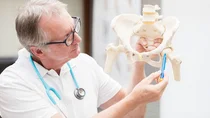
A hip joint is made up of the head of the thighbone (femur) and the socket of the hip joint on the pelvic bone. Both are covered with protective cartilage. Osteoarthritis of the hip develops when the joint cartilage softens, cracks, and thins. As a result, the bones are no longer as well protected from the pressure of weight-bearing activities. They react by forming bony outgrowths to distribute the pressure over a larger area (these are known as bone spurs or osteophytes).
Colloquially, osteoarthritis is also often referred to as “joint wear and tear”. However, this term is misleading, as the joint is not “worn out” through use – on the contrary: Cartilage relies on movement to be supplied with nutrients. For example, forms of exercise such as walking or cycling are beneficial for joints and cartilage.
Sports such as handball or football, on the other hand, can put too much strain on the joints and contribute to osteoarthritis. This also applies to strenuous physical work or severe obesity. This is because joint overload can throw the metabolic processes within the joint out of balance. In such cases, too many substances and enzymes are produced that promote inflammation and lead to tissue breakdown – and too few that counteract this.
Several factors often play a role in the development of osteoarthritis of the hip, including:
- family history
- severe overweight (obesity)
- congenital anomalies of the hip (hip dysplasia)
- rare congenital hip disorders
- heavy physical work, for example construction work
- continuous stress from intensive training, especially types of sports that put intense pressure on the body such as football or handball
- inflammatory joint diseases such as rheumatoid arthritis
- previous hip injuries, e.g. bone fractures in the hip joint or a dislocated hip joint
- hip impingement – where bony spurs on the joint cause pinching to occur between the head of the femur and socket
How common is osteoarthritis of the hip?
In Germany, around 5 percent of adults have osteoarthritis of the hip with symptoms. More women than men are affected.

How does osteoarthritis of the hip develop?
How osteoarthritis of the hip develops varies considerably. A large study in the Netherlands observed how the disease progresses by regularly examining patients over a period of 5 years. This produced the following results:
- 40 percent had mild, relatively constant pain over the entire period.
- 20 percent had moderate, likewise relatively constant pain.
- 25 percent had moderate pain that became more intense over the 5 year period.
- 15 percent suffered from persistent, severe pain.
A follow-up examination after ten years confirmed the study results. Within 10 years, 12 out of 100 people opted for an artificial hip joint.

Important: The symptoms can also occur in flare-ups. This involves phases of more severe pain alternating with periods that are symptom-free or cause little discomfort.
How is osteoarthritis of the hip diagnosed?
A diagnosis can usually be made if a patient presents with the typical symptoms of osteoarthritis of the hip. One typical symptom is the type of “start-up pain” that occurs after prolonged periods of inactivity and that disappears again quickly with movement of the joint.
The doctor takes a detailed medical history, asking specific questions about how the condition has progressed so far and its symptoms, for example: how long has the person been experiencing pain, when does it occur, how does it feel? Does the pain only occur when moving or also when at rest? Are the joints stiff in the morning? Were there any previous injuries?
As well as asking questions, the doctor feels the joint and examines how well it can move, looks at the person’s gait and checks whether there is any pelvic obliquity or whether the legs are of different lengths.
X-rays, ultrasound scans, computed tomography (CT) scans and magnetic resonance imaging (MRI) scans are often not very conclusive in the case of osteoarthritis. For example, there are people with significant joint changes who experience hardly any symptoms, and others with severe symptoms whose joints look healthy. Studies show that only a quarter of people with osteoarthritis visible on X-ray experience pain. Therefore, this type of imaging does not often provide any further useful information. In any case, treatment should be based on the symptoms and the individual situation.
However, imaging tests or blood tests may be useful if the symptoms indicate another condition, such as rheumatoid arthritis or gout. They are also needed after a fall or accident and for planning an operation.
How is osteoarthritis of the hip treated?
Osteoarthritis of the hip cannot be cured. However, various treatments can relieve the symptoms. Most importantly, there are many things you can do yourself to strengthen the joint.
Recommended treatments primarily include:
- exercise therapies such as physiotherapy with exercises to strengthen the thigh and hip muscles
- rehabilitative sports, functional training, water aerobics and Tai Chi
- non-steroidal anti-inflammatory drugs (NSAIDs) for oral use – they can also help you stay active despite the pain.
- weight loss in cases of severe obesity
In addition, it is recommended to wear well-cushioned, supportive, and comfortable flat shoes.

Cortisone injections can also demonstrably relieve the symptoms of osteoarthritis of the hip. However, the effect wears off over time and ends after 2 to 3 months. Cortisone injections are generally considered beneficial when only a single joint is affected by osteoarthritis, the hip joint is acutely inflamed, or is very painful.
However, cortisone injections are not a long-term solution. For one thing, repeated injections can weaken the joint cartilage over the long term. For another thing, every injection can have side effects and, in rare cases, also lead to serious complications such as an infection.
Because only a few studies have investigated the effectiveness of cortisone injections in osteoarthritis of the hip, there are varying recommendations for use. When cortisone injections are used, it is important that the doctor has experience with it and ensures proper hygiene. For example, they should use an ultrasound machine to administer the injection correctly, ensuring it works as well as possible and avoids injuring nerves, vessels or other structures.
If advanced osteoarthritis severely impairs daily life and quality of life and other treatments are not enough, an artificial hip joint may be an option. After the operation, active rehabilitation is important – and a little patience. It can take a few weeks or months for the person to get used to the new joint and the body to recover from the procedure.
There is no evidence that other treatments help with osteoarthritis of the hip – they include:
- analgesic creams
- paracetamol
- hyaluronic acid injections
- low-dose X-ray irradiation (also: orthovoltage therapy)
- dietary supplements, for example with chondroitin, glucosamine or vitamins
- herbal supplements, for example based on rampion or stinging nettles
- acupuncture
- foods or food extracts with for instance a soy or avocado base
- therapeutic ultrasound, laser treatments, TENS treatments or special heat treatments (diathermy)
For more detailed information, such as what you can do to strengthen your hip joints, visit gesundheitsinformation.de.
What is life like with osteoarthritis of the hip?
Advanced osteoarthritis of the hip can make everyday life more difficult on many levels. However, over time, many people learn to cope well with life despite their condition – for example, they take more time for different kinds of strenuous activity, such as household work, and adjust what they do accordingly.
Walking aids can make movement easier, both inside and outside the apartment – walking sticks, walkers or wheeled walkers take pressure off the joints. Experts – physiotherapists and occupational therapists, as well as medical practitioners of various specialties, such as orthopedics, rheumatology and geriatrics – can explain how to use and correctly set up these aids.
- Bannuru RR, Osani MC, Vaysbrot EE et al. OARSI guidelines for the non-surgical management of knee, hip, and polyarticular osteoarthritis. Osteoarthritis Cartilage 2019; 27(11): 1578-1589.
- Bastick AN, Verkleij SP, Damen J et al. Defining hip pain trajectories in early symptomatic hip osteoarthritis - 5 year results from a nationwide prospective cohort study (CHECK). Osteoarthritis Cartilage 2016; 24(5): 768-775.
- Da Costa BR, Pereira TV, Saadat P et al. Effectiveness and safety of non-steroidal anti-inflammatory drugs and opioid treatment for knee and hip osteoarthritis: network meta-analysis. BMJ 2021; 375: n2321.
- Deutsche Gesellschaft für Orthopädie und Unfallchirurgie (DGOU). Evidenz- und konsensbasierte Indikationskriterien zur Hüfttotalendoprothese bei Coxarthrose (EKIT-Hüfte) (S3-Leitlinie). AWMF-Registernr.: 187-001. 2021.
- French HP, Abbott JH, Galvin R. Adjunctive therapies in addition to land-based exercise therapy for osteoarthritis of the hip or knee. Cochrane Database Syst Rev 2022; (10): CD011915.
- Gazendam A, Ekhtiari S, Bozzo A et al. Intra-articular saline injection is as effective as corticosteroids, platelet-rich plasma and hyaluronic acid for hip osteoarthritis pain: a systematic review and network meta-analysis of randomised controlled trials. Br J Sports Med 2021; 55(5): 256-261.
- Heerey JJ, Kemp JL, Mosler AB et al. What is the prevalence of imaging-defined intra-articular hip pathologies in people with and without pain? A systematic review and meta-analysis. Br J Sports Med 2018; 52(9): 581-593.
- Hunter DJ, Bierma-Zeinstra S. Osteoarthritis. Lancet 2019; 393(10182): 1745-1759.
- Katz JN, Arant KR, Loeser RF. Diagnosis and Treatment of Hip and Knee Osteoarthritis: A Review. JAMA 2021; 325(6): 568-578.
- Kim C, Nevitt MC, Niu J et al. Association of hip pain with radiographic evidence of hip osteoarthritis: diagnostic test study. BMJ 2015; 351: h5983.
- Kolasinski SL, Neogi T, Hochberg MC et al. 2019 American College of Rheumatology/Arthritis Foundation Guideline for the Management of Osteoarthritis of the Hand, Hip, and Knee. Arthritis Rheumatol 2020; 72(2): 220-233.
- Leopoldino AO, Machado GC, Ferreira PH et al. Paracetamol versus placebo for knee and hip osteoarthritis. Cochrane Database Syst Rev 2019; (2): CD013273.
- Liu X, Machado GC, Eyles JP et al. Dietary supplements for treating osteoarthritis: a systematic review and meta-analysis. Br J Sports Med 2018; 52(3): 167-175.
- Metcalfe D, Perry DC, Claireaux HA et al. Does This Patient Have Hip Osteoarthritis?: The Rational Clinical Examination Systematic Review. JAMA 2019; 322(23): 2323-2333.
- Schmidt CO, Günther KP, Goronzy J et al. Häufigkeiten muskuloskelettaler Symptome und Erkrankungen in der bevölkerungsbezogenen NAKO Gesundheitsstudie [Frequencies of musculoskeletal symptoms and disorders in the population-based German National Cohort (GNC)]. Bundesgesundheitsblatt Gesundheitsforschung Gesundheitsschutz 2020; 63(4): 415-425.
- Skelly AC, Chou R, Dettori JR et al. Noninvasive Nonpharmacological Treatment for Chronic Pain: A Systematic Review Update. (AHRQ Comparative Effectiveness Reviews; Band 227). 2022.
- Ton J, Perry D, Thomas B et al. PEER umbrella systematic review of systematic reviews: Management of osteoarthritis in primary care. Can Fam Physician 2020; 66(3): e89-e98.
- Van Berkel AC, Schiphof D, Waarsing JH et al. 10-Year natural course of early hip osteoarthritis in middle-aged persons with hip pain: a CHECK study. Ann Rheum Dis 2021; 80(4): 487-493.
- Zeng C, Wei J, Persson MSM et al. Relative efficacy and safety of topical non-steroidal anti-inflammatory drugs for osteoarthritis: a systematic review and network meta-analysis of randomised controlled trials and observational studies. Br J Sports Med 2018; 52(10): 642-650.