Healthy living Emergency care – what happens after an emergency call?
When it comes to life-threatening conditions or serious accidents, rapid assistance is key. Emergency care by rescue services follows a clear procedure – from the emergency call to the transportation to the hospital. Help is also available 24/7 from special rescue services.
At a glance
- Emergencies can occur at any time. When they do, an emergency call has to be placed immediately and first aid provided where possible.
- The emergency control centers can be contacted at all times to ensure rapid assistance.
- The emergency control center decides which emergency personnel and equipment are required.
- Emergency personnel provide emergency medical care on site and safe transportation to a hospital.
- Special rescue equipment is available for rescue operations in the mountains and water as well as for caring for newborns and stroke patients.
- Reforms and new technologies such as telemedicine should further improve emergency care in the future.


What is a medical emergency?
A medical emergency is primarily deemed to exist if a person’s health condition suddenly deteriorates to become life threatening. These are situations where vital functions such as breathing, the circulatory system or consciousness are impaired. Such impairments can be caused by illness, an accident or poisoning, for example.

What should I do in a medical emergency?
It may be difficult, but try to remain calm. The most important things to do in a medical emergency are:
- Call the emergency services on 112
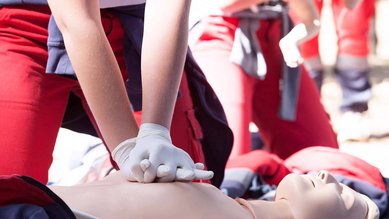
- Administer first aid
Depending on the type of emergency, different actions are required. For example, in the event of an accident, the accident site needs to be made safe. Several first aid measures also need to be performed. Which measures these are can be found in the article First aid – be brave and take action.
After calling the emergency services on 112, you will be connected to the emergency control center. The operator asks for all necessary information about the accident using a fixed sequence of set questions. They also assess the urgency in order to deal with life-threatening emergencies as quickly as possible. Stay on the line to answer any queries and receive instructions. The control center can also guide you through resuscitation measures if necessary.
The article Numbers to call in the event of an emergency provides the details of further points of contact, for example in the event of poisoning or mental crises.
What happens after an emergency call has been placed?
After answering the emergency call, the control center operator inputs all the information about the emergency into a computer system. Even during the call, a second person starts to alert the necessary emergency services.
In addition to the emergency personnel, professional helpers near to the emergency can be alerted. This could include medical specialists, members of the fire service or police or company emergency responders, for example. Trained laypeople can also be informed via first aider apps. This should bridge the time between the emergency call and the arrival of the emergency services.
Anyone who has been trained as a first aider can receive information about nearby emergencies via smartphone apps and provide assistance if necessary. Further information about these kinds of first aider systems can be found on the website of the German Resuscitation Council (GRC) e.V.
Emergency personnel
Several professional groups work together in the emergency services:
- Emergency paramedics (Notfallsanitäter) have completed several years of training. This enables them to independently care for people with life-threatening illnesses and injuries. For example, they administer infusions and emergency medication. They also provide support once the emergency doctor has arrived. The former paramedic (Rettungsassistent) training has now been replaced by emergency paramedic (Notfallsanitäter) training.
- Emergency medical technicians (Rettungssanitäter) have completed a three-month training course. They drive emergency ambulances and support the emergency paramedics.
- Trained ambulance support workers (Rettungshelfer) are primarily used to transport patients. They can also assist the paramedics.
- Emergency doctors (Notärzte) have completed not only their medical studies but also specific additional qualifications in emergency medicine. They have experience in caring for critically ill patients and can, for example, treat threatening cardiac arrhythmias or perform emergency anesthesia.
Emergency vehicles
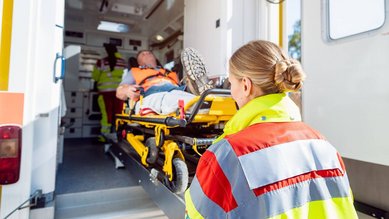
Following the emergency call, the control center dispatches an emergency ambulance, emergency doctor’s vehicle or a non-emergency ambulance, depending on the situation. Emergency ambulances generally have an emergency paramedic and an emergency medical technician on board.
Such ambulances are colloquially known as “mobile intensive care units” as they are equipped with a wide range of medical technology to treat life-threatening emergencies. These include:
- a ventilator
- a defibrillator with a pacemaker function
- various types of medication
- infusions
- bandages
If an emergency doctor is required on site, an emergency doctor’s vehicle is dispatched. This is the case with around one in five emergency calls. An emergency doctor is needed, for example, if someone has stopped breathing, suffered a cardiac arrest or had a serious traffic accident.
Emergency doctor ambulances are also available in some regions. These vehicles are equipped similarly to emergency ambulances but also have an emergency doctor on board. An emergency doctor can also be called out retrospectively if an emergency ambulance has initially been dispatched to an emergency. In rural regions in particular, medical tele-emergency services can also be involved.
Non-emergency ambulances are not used to deal with serious emergencies but to transport ill and injured people under medical supervision.
The emergency control center uses the information provided by the emergency personnel to determine which hospital the patient should be taken to. This is the nearest hospital that is equipped to deal with the medical condition and has free capacities.


Special emergency operations
Some emergencies require specifically qualified specialists and special vehicles.
In certain cases, a rescue helicopter is used, for example if a seriously ill patient needs to be quickly taken to a specialist hospital or someone with a spinal injury needs to be transported additional distances with as little vibration as possible. Specially equipped intensive-care helicopters also exist for patients who need intensive care during the flight. Rescue helicopters are particularly indispensable for rescues from the water, in impassible terrain or in the mountains.
The mountain rescue service, often abbreviated to just mountain rescue, cares for injured or ill people in the mountains, including under challenging conditions, for example mountaineers who have had an accident. They also deal with cable car evacuations and rescue operations in caves or following avalanches. Search operations, including using rescue dogs, are sometimes required.
Good to know: Anyone doing sport in the mountains should first familiarize themselves with mountain first aid and the alpine distress signal. Further information can be obtained from the German Alpine Association (DAV).
Water rescue services or lifeguard services provide assistance in the event of swimming and boat accidents in rivers, lakes and coastal areas as well as on the ice in winter. Water rescue training includes monitoring water bodies, lifesaving swimming and public safety diving.
Emergency phones, which can be used to place an emergency call to the water rescue services at the push of a button, are installed on many beaches and by many water bodies.
Special rescue equipment is also available for certain medical conditions and patient groups:
Baby ambulances can be used to safely transport newborns. During the journey, the child is cared for by a doctor and other medical specialists trained in newborn care.
Specially equipped rescue vehicles known as mobile stroke units (MSU) have been developed to deal with strokes. These are sometimes also known as stroke emergency mobiles (STEMO).
STEMO or MSU are equipped with a computer tomograph (CT), an X-ray machine and a mini laboratory. Their crew comprises not only emergency personnel but also a neurologist who is trained in emergency care. A CT scanner enables them to directly investigate the cause of the stroke at the scene and instigate treatment.
Interesting fact: Treatment in this kind of a special emergency ambulance significantly increases the chances of survival and recovery after a stroke. However, only a few STEMO/MSU are in operation due to the high technical, financial and personnel costs.

In some areas, the use of medical intervention cars is being trialed. These vehicles come with equipment such as a heart-lung machine and make it possible to perform special emergency medical interventions and blood transfusions.
In rare cases, lots of injured people have to be treated at the same time, for example in the event of serious traffic incidents or major fires. The term “mass-casualty incident”, abbreviated to MCI, is also used for such situations. Emergency medical services, the fire brigade, the police and aid organizations have to work hand in hand. While the other emergency services secure the accident scene, the emergency medical services assess the injured. The aim is to treat the people who are seriously injured first, tend to everyone who is injured as quickly as possible and take people to suitable hospitals. Specially developed concepts and exercises have been established for such incidents so that help can be provided quickly and effectively even in such cases.
Emergency care in hospitals
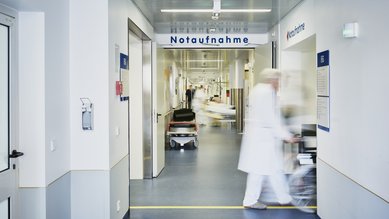
Following arrival in the emergency department, the emergency personnel pass on all important information about the emergency to the emergency department team.
Further information about treatment in the emergency department can be found in our article Emergency departments – the port of call for medical emergencies. Once care has been provided in the emergency department, patients will be discharged home, admitted to a hospital ward or transferred to another hospital.
What developments are there with regard to emergency care?
Several developments are currently taking place with regard to emergency care in Germany. These aim to improve the efficiency, quality and accessibility of the care.
Telemedicine
The use of telemedical measures is also expected to become more prevalent in emergency care in future. This can particularly improve care in rural regions.
Emergency personnel in the municipality
In some regions, the use of municipal emergency paramedics and acute community nurses is being trialed. In addition to their paramedic or nursing training, these are also specially qualified to deal with emergency situations. Emergency control centers can instruct them to attend to people who are acutely ill, for example to assess their health, perform treatments and coordinate further care.
These specialists can also be involved in caring for people who are chronically ill, for example if their health acutely deteriorates.
The aim is to ensure rapid medical care while also preventing unnecessary hospital referrals.
Emergency care reform
In many places, emergency services, emergency departments and hospitals are overstretched. Patients are often not cared for in line with their needs. To receive needs-oriented care, it is not always necessary to go to an emergency department. For example, non-emergency medical assistance practices are the right port of call for optimum care for several acute conditions.
In view of the above, the Federal Ministry of Health (Bundesministerium für Gesundheit) is currently drafting a law to reform emergency care. This aims to strengthen collaboration between different areas of emergency care, including rescue services, emergency medical assistance, emergency departments and even emergency pharmacies. Patients should receive suitable care quicker in emergencies.
- Björn Steiger Stiftung. Notrufbearbeitung. Aufgerufen am 18.09.2025.
- Deutsches Rotes Kreuz e.V. (DRK). Rettungsablauf. Aufgerufen am 18.09.2025.
- Deutsches Rotes Kreuz (DRK)- Landesverband Baden-Württemberg e.V. Ausbildung im Rettungsdienst. Aufgerufen am 18.09.2025.
- Malteser Hilfsdienst e.V. Fahrzeuge im Rettungsdienst. Aufgerufen am 18.09.2025.
- Regierungskommission für eine moderne und bedarfsgerechte Krankenhausversorgung. Vierte Stellungnahme und Empfehlung der Regierungskommission: Reform der Notfall- und Akutversorgung in Deutschland. Stand: 13. Februar 2023.
- Stiftung Deutsche Schlaganfall Hilfe. Mobile Stroke Units verbessern Schlaganfall-Versorgung. Aufgerufen am 18.09.2025.
- Stiftung Gesundheitswissen. Wohin im medizinischen Notfall? Aufgerufen am 18.09.2025.
- Wissenschaftliche Dienste des deutschen Bundestages. Überblick über die Notfallversorgung in Deutschland. Stand: 10.06.2022.
As at: