Conditions Overactive thyroid
ICD codes: E05 What are ICD codes?
The thyroid gland regulates many body functions. When overactive, it produces too many hormones, imbalancing the metabolism. This can be treated in various ways.
At a glance
- The thyroid gland produces important hormones that regulate the metabolism.
- When overactive, the thyroid gland produces too many hormones, speeding up the metabolism.
- Typical symptoms include weight loss, nervousness and a racing heart (tachycardia).
- An overactive thyroid is more common in women than men.
- There are various methods available for treating an overactive thyroid. In most cases, the excess hormone production is stemmed through the use of tablets.
Note: The information in this article cannot and should not replace a medical consultation and must not be used for self-diagnosis or treatment.


What is an overactive thyroid?
The thyroid gland is a hormone gland that regulates several bodily functions. If it produces too many hormones, this is referred to as an overactive thyroid (hyperthyroidism). Such overactivity can have various causes. The most common of these is the thyroid condition known as Basedow’s disease.
If the volume of thyroid hormones in the blood is persistently higher than usual, many bodily functions run “in overdrive” unnecessarily. This can result in a number of different symptoms, typically including weight loss, perspiration, nervousness or a racing heart tachycardia.
If left untreated, an overactive thyroid increases the risk of cardiovascular disease.
Video What are the common forms of thyroid disease?
This video explains what the most common forms of hypothyroidism and hyperthyroidism are, what causes them and how they are treated.
This and other videos can also be found on YouTube
Watch nowThe privacy policy indicated there applies.
What are the symptoms of an overactive thyroid?
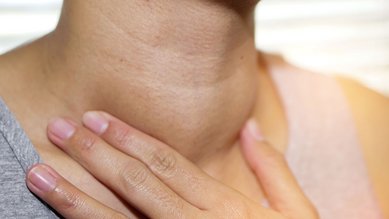
In the case of an overactive thyroid, the thyroid gland often becomes enlarged and visible swelling appears on the neck. Doctors refer to this enlargement as a goiter (struma). Sometimes the entire gland is not swollen; instead, only palpable or visible nodules form. However, an overactive thyroid can also occur without a goiter or nodules – and both of these can also have other causes.
Too many thyroid hormones in the blood cause an imbalance in the various metabolic and bodily functions. This brings various symptoms, including the following:
- heart palpitations and racing heartbeat, sometimes even cardiac arrhythmia
- high blood pressure
- weight loss despite feeling hungry more often
- diarrhea
- trembling, nervous anxiety, irritability, insomnia
- weakness, fatigue
- sweating
People with an overactive thyroid also quickly find heat unpleasant. Their skin often feels warm and moist, and their hair starts to thin.
If Graves’ disease has caused it, bulging eyes and visual disturbances can also occur.
What causes an overactive thyroid?
The most common cause of an overactive thyroid is Basedow’s disease, an autoimmune disease of the thyroid gland. This is a condition where the immune system produces antibodies that stimulate the thyroid gland to produce excess hormones.
Thyroid autonomy can also cause the thyroid to produce too many hormones. The thyroid gland is usually controlled by the pituitary gland. It constantly “measures” whether the correct amount of thyroid hormones is produced, and ensures balance when needed. When a thyroid gland starts functioning “autonomously”, the thyroid cells stop responding to the signals sent by the pituitary gland. This can cause increased production of thyroid hormones.
Autonomous thyroid cells sometimes occur throughout the entire gland and sometimes only in the tissue of one or more benign nodules. Such nodules are known as autonomous thyroid adenoma.
Sometimes, too much thyroid hormone also enters the bloodstream when the thyroid gland becomes inflamed: Then stored thyroid hormones are released from the inflamed tissue, and symptoms resembling hyperthyroidism occur temporarily.
How common is an overactive thyroid?
Approximately 1 in 100 people have an overactive thyroid. Women develop an overactive thyroid more often than men. The condition usually occurs in middle age.

What are the possible consequences of an overactive thyroid?
If not treated properly, an overactive thyroid may cause cardiovascular problems such as atrial fibrillation. In the long term, the accelerated bone remodeling process may also lead to osteoporosis.
In rare cases, an overactive thyroid leads to a life-threatening situation called a thyrotoxic crisis. Various factors can trigger this condition, including medications and X-ray contrast agents. In addition to the typical symptoms of an overactive thyroid, patients may also experience high fever, vomiting, restlessness and anxiety, heart rhythm disturbances and impaired consciousness, progressing to coma and circulatory. Thyrotoxic crisis is an emergency – those affected with it must be treated in an intensive care unit.
How is an overactive thyroid diagnosed?
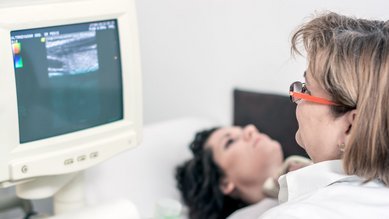
The first step in diagnosing an overactive thyroid is a detailed medical consultation. This is usually followed by a physical examination where the doctor feels the thyroid gland to see whether it is enlarged or if a nodule has perhaps formed. An ultrasound examination can be used to more precisely identify and assess changes to the thyroid tissue and existing nodules.
An examination of the eyes can also be useful. For example, bulging, swollen eyes can indicate a presence of Basedow’s disease – the most common cause of an overactive thyroid.
Blood tests also provide important information. They can be used to determine whether the thyroid itself is producing too many hormones or whether the overproduction is the result of the pituitary gland not properly controlling production. It is also possible to detect certain antibodies in the blood that can provide further indications of the presence of Basedow’s disease.
An overactive thyroid and its cause can be detected using various tests. Information about the various thyroid tests can be found at gesundheitsinformation.de.
How is an overactive thyroid treated?
In mild cases, an overactive thyroid can sometimes go away of its own accord. In most cases, however, the excess hormone production by the thyroid gland has to be stopped using thyreostatics. These are a type of medication that inhibits the production of thyroid hormones. If the medication is stopped, the overactive thyroid may return. In such cases, the gland is first “calmed” again with thyrostatic drugs, and then operated on or treated with radioiodine.
If a solitary thyroid nodule is responsible for the overactive thyroid, a procedure in which only this node is excised may suffice. Otherwise, the operation usually involves removing the entire gland. Sometimes, a small amount of residual thyroid tissue is left, which continues to produce hormones.
Radioactive iodine therapy involves ingesting radioactive iodine, which accumulates in the thyroid gland and destroys the cells that produce too many hormones. This treatment is often an option when surgery is not possible or desired.

More detailed information on the treatment of an overactive thyroid can be found at gesundheitsinformation.de.
- Bartalena L, Kahaly GJ, Baldeschi L et al. The 2021 European Group on Graves' orbitopathy (EUGOGO) clinical practice guidelines for the medical management of Graves' orbitopathy. Eur J Endocrinol 2021; 185(4): G43-G67.
- De Leo S, Lee SY, Braverman LE. Hyperthyroidism. Lancet 2016; 388(10047): 906-918.
- Deutschen Gesellschaft für Allgemein- und Viszeralchirurgie (DGAV). S2-Leitlinie Operative Behandlung benigner Schilddrüsenerkrankungen. 2021.
- Deutsche Gesellschaft für Nuklearmedizin (DGN). S1-Leitlinie Radioiodtherapie bei benignen Schilddrüsenerkrankungen. AWMF-Registernr.: 031-003. 2022.
- Jameson JL, Mandel SJ, Weetmann AP. Disorders of the Thyreoid Gland. In: D. L. Kaspers, S. L. Hauser, J. L. Jameson et al (Ed). Harrison's Principles of Internal Medicine. McGraw-Hill Education; 2015.
- Kahaly GJ, Bartalena L, Hegedüs L et al. 2018 European Thyroid Association Guideline for the Management of Graves’ Hyperthyroidism. Eur Thyroid J 2018; 7(4): 167-186.
- National Institute for Health and Care Excellence (NICE). Thyroid disease: assessment and management (NICE Guidelines; Band NG145). 2019.
- Ross DS, Burch HB, Cooper DS et al. 2016 American Thyroid Association Guidelines for Diagnosis and Management of Hyperthyroidism and Other Causes of Thyrotoxicosis. Thyroid 2016; 26(10): 1343-1421.