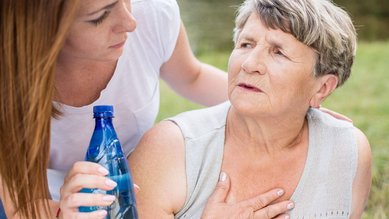
Healthy living Traveling with chronic illnesses
In many cases, people with a chronic illness or restricted mobility can still successfully travel. Foresighted planning makes it possible to properly prepare for trips.
At a glance
- Vacations can be relaxing and recuperating – even for people with physical limitations.
- Timely planning is important so that special needs can be considered.
- Medical advice should be obtained at an early stage when planning travel.
- The local infrastructure but also the climate, culture or language could have an impact on the choice of destination.
- When traveling abroad, entry requirements must be considered, for example required vaccinations or regulations on taking medication into the country.
- Important documents should be prepared in the national language or English so they can be understood by customs officials and medical staff abroad.


How can chronic illnesses affect travel?
Even people with a chronic illness or restricted mobility can travel on vacation. A relaxing vacation improves general wellbeing and self-esteem. Furthermore, vacations can be good for many medical conditions.
People with diabetes, heart failure, COPD, chronic kidney disease or immune deficiencies often ask themselves whether they can travel at all. Concern about flare-ups can deter people with multiple sclerosis or chronic inflammatory bowel disease such as Crohn’s disease or ulcerative colitis from long-distance travel. Depending on the means of transport, travel puts strain on the body. In some cases, people’s well-being can also be impaired by unfamiliar local climate conditions or the change of time zone. Furthermore, not all forms of transport and destinations are suitable for people with limited mobility or who require assistance.
Reliable medical care is important for many chronic illnesses. Medical treatment may be required while traveling. If a person’s health deteriorates, in the worst case, a vacation may have to be cut short. However, many health-related difficulties can be overcome through timely and careful planning.
What do I need to consider when planning travel?
Medical advice
Stable health is essentially a prerequisite for the ability to travel. People should discuss travel plans with their doctor in good time prior to booking and at least 2 months prior to traveling. These discussions should cover the following points:
- personal resilience
- vaccine protection
- travel medical kit with regular and pro re nata (PRN) medication
- consumables such as disinfectant or disposable gloves
- the potential need to adjust medication doses, for example due to time changes or weather-induced strain on the cardiovascular system
- what to do in an emergency and potential contacts
People should take a sufficient stock of medication with them in case their return journey is unexpectedly delayed.

Information about currently recommended travel vaccinations can be found on the Robert Koch Institute website.
Specialist doctors, tropical institutes and even some public health authorities offer personal advice on travel medicine.
Good to know: When staying in EU member states for longer periods, it is also possible to obtain special prescriptions for medication and medical devices in Germany, which can be redeemed in the destination country. If you wish to redeem a prescription while abroad, always notify your doctor. This will enable all necessary information to be provided on the prescription.
Means of transport
When choosing a means of transport, people should consider their personal level of resilience. Reservations are always wise as capacities can often be limited. People with limited mobility can use assistance services at the airport or train station. In addition to supplying wheelchairs, these can carry luggage or help people get onto transport. The use of support services should be requested in good time prior to the date of travel.
Information about accessible train journeys can be found on the Deutsche Bahn website. The charitable organization Bahnhofsmission is also a good port of call.
Information about air travel with limited mobility can be found on the Federal Aviation Office (Luftfahrt-Bundesamt) website.
People with special dietary needs when traveling, for example due to intolerances, should ask the transport company about these.
Good to know: People should always obtain written confirmation when booking services suitable for disabilities, such as an accessible hotel room. A written confirmation is legally binding and can act as evidence in the event of doubt.
What should be considered when choosing a travel destination?
Which travel destinations are suitable depends on people’s individual limitations and needs. Some chronic illnesses can temporarily become worse. If this happens, depending on the illness, people can need PRN medication (prescribed medication only taken as needed) or even treatment by medical personnel. When choosing a travel destination, people should consider whether there are appropriate medical practices or hospitals nearby. The following aspects should also be considered with regard to medical care:
- What is the standard of the local healthcare system?
- How is the local healthcare organized?
- Are there English-speaking or German-speaking personnel?
- What options does the local infrastructure offer, for example is there any local public transport or are there transfer services?
- Are there any local pharmacies, medical practices or hospitals, and what types of medication are usually available from these?
Anyone who requires regular treatment due to a chronic illness can generally also get this while abroad. For example, vacation dialysis is available for people in need of dialysis. Dialysis centers can help you find dialysis services in your vacation destination.
Anyone who relies on a hearing dog, guide dog or other assistance animals should find out about entry restrictions, quarantine rules and vaccination requirements in good time.
Do I need additional documents or certificates when traveling?
In addition to their standard travel documents, people should also take the following medical documents with them, where possible in the relevant national language or English:
- General information about existing illnesses, required medication, allergies, intolerances and what to do in an emergency
- An information sheet listing all medication and medical aids taken with them
- Fit to fly certificate, if required by the airline
For some medication, for example strong painkillers or the ADHD medication methylphenidate, people have to present a medical certificate upon arrival confirming the need for the medication. In some cases, this even has to be certified by the local health authority.
The Federal Institute for Drugs and Medical Devices (BfArM) provides detailed information on its website about traveling with medication that falls under the Federal Narcotics Act (BtMG).
Good to know: Even when traveling, medication must be correctly stored. This particularly means keeping an eye on its temperature. For example, insulin can be protected against frost or heat through the use of an insulated bag or a thermal cup.
Luggage insurance can be wise when traveling with medical aids. People should check their insurance cover carefully regardless of their health condition. Depending on the destination country and insurance status, an international health insurance certificate or additional insurance such as repatriation insurance may be required.
What should I consider when traveling by air?
When traveling by air, time management is important. Giving yourself plenty of buffer makes the whole experience less stressful. This also applies to journeys that involve connecting flights. In some cases, people have to wait for local support services. Furthermore, physically disabled passengers tend to be the last to disembark the airplane.
The following points should be considered so that all necessary items and medication can be taken through security controls without issue:
- Indicate any sensitive medical devices in good time, for example cochlear implants, pacemakers, insulin pumps, mobile dialysis units or braille terminals
- Only use leak-proof batteries in electric wheelchairs
- Register special luggage in good time
The following items should be packed in hand luggage:
- Medication and medical aids needed in the first few days
- Cold-sensitive medication
- Disability card
- For guide dogs or other assistance animals: certificates of vaccination
- Customs carnet: required in some non-EU-countries, for example to take a wheelchair into the country without paying customs
- Prescriptions for medication

The German Aviation Association (BDL) provides a brochure on its website with all relevant information for air passengers with limited mobility.
What should I consider while abroad?
People with chronic illnesses are sometimes more susceptible to certain pathogens. They are also often at higher risk of serious cases of illness. To protect themselves against contagious illnesses while traveling, people should follow general hygiene measures. As the appropriate measures partially depend on the quality of the water available, finding out about the quality of the local drinking water is an important first step.
The Federal Foreign Office provides information on its website about key hygiene rules when traveling.
People may need to adapt their activities while abroad. For example, physical effort at high altitudes can exacerbate symptoms in the event of existing cardiovascular disease. Organizers can be asked about the duration and difficulty of activities in advance. People should also take enough medication on excursions, including to suffice in the event of an unplanned overnight stay.
For people with metabolic disorders or allergies, the typical diet in destination countries can be difficult to assess. Temperatures or activities to which people are not accustomed can affect the metabolism and modify energy requirements.
People with diabetes should pay particular attention to their feet, regularly checking them for injuries and caring for any pressure points or rubbed areas in good time. Sharp-edged shells on the beach can cause skin injuries. Suitable footwear is required for longer sightseeing walks or hikes.
Further information
The ambulante dienste e.V. website provides a list of non-commercial medical aids.
Various help services offer leisure activities for their target groups. These trips also provide the opportunity to talk to other people with the same condition. Such leisure activities are offered by the Württemberg Evangelical Service for the Blind and Visually Impaired (Evangelische Blinden- und Sehbehindertendienst Württemberg e.V.) and the German Diabetes Federation (Deutsche Diabetiker Bund), for example.
Information about vacation dialysis can be obtained from dialysis providers such as Diaverum, Nephrocare or the Association of German Kidney Centers (Verband Deutscher Nierenzentren).
The following federal associations furthermore offer advice and support:
- Federal Association of Self-Help for the Physically Disabled (Bundesverband Selbsthilfe Körperbehinderter e.V.)
- Federal Association for Vital Help (Bundesvereinigung Lebenshilfe e.V.)
- Federal Association for People with Physical and Multiple Disabilities (Bundesverband für körper- und mehrfachbehinderte Menschen e.V.)
Municipalities and city councils have disability officers who provide information about regional services.
- Apotheken.de. Reisen mit chronischer Krankheit. Aufgerufen am 04.07.2025.
- Bundesverband der DeutschenLuftverkehrswirtschaft e.V. (BDL), Deutscher Behindertenrat (DBR), Bundesarbeitsgemeinschaft der Senioren-Organisationen (BAGSO) e.V., Tourismus für Alle Deutschland e.V. (NatKo). Barrierefreies Reisen mit dem Flugzeug. Stand: Januar 2025, 3. Auflage.
- EU-Patienten.de. Wie löse ich meine in Deutschland ausgestellten Verschreibungen ein? Aufgerufen am 04.07.2025.
- PTA heute. Diabetes: Insulin bei Kälte richtig lagern. Aufgerufen am 04.07.2025.

Reviewed by the Consumer Advice Center of North Rhine Westphalia (Verbraucherzentrale Nordrhein-Westfalen)
As at: