Conditions Overactive parathyroid glands
ICD codes: E21.0 E21.1 E21.2 E21.3 What are ICD codes?
Hyperparathyroidism (overactive parathyroid glands) is a hormone disorder that causes increased calcium in the blood. This can lead to bone degradation, kidney stones, gastrointestinal complaints and cognitive and psychological effects. Surgical intervention is often successful.
At a glance
- The parathyroid glands are a number of small hormone-producing glands located behind the thyroid gland.
- An overactive parathyroid gland remains without symptoms for a long time. It is often only noticed by chance due to elevated calcium levels in the blood.
- In the long term, an overactive parathyroid gland can lead to a wide range of symptoms and complications.
- The cause is often a parathyroid adenoma – a benign nodule that produces excessive amounts of hormone.
- An adenoma can be surgically removed.
- An overactive parathyroid gland is sometimes caused by another underlying condition. If it is treated, parathyroid function also returns to normal.
Note: The information in this article cannot and should not replace a medical consultation and must not be used for self-diagnosis or treatment.


What is meant by overactive parathyroid glands?
The parathyroid glands are a number of small hormone-producing glands, roughly the size of a pea, located in the neck behind the thyroid gland, which function independently of the thyroid.

The parathyroid glands regulate the body’s calcium content. For this purpose, they produce parathyroid hormone (PTH) – also called parathormone. It ensures that the correct amount of calcium is always present in the blood. This happens primarily in two ways:
- Calcium is stored in the bone as a building material. If there is too little calcium in the blood, parathyroid hormone causes the bones to release calcium.
- When calcium levels are too low, parathyroid hormone ensures that calcium is not excreted with the urine, but is “retrieved” from the urine and re-enters the bloodstream.
An overactive parathyroid gland (hyperparathyroidism) produces too much parathyroid hormone. This leads to an increased release of calcium from the bones, which cannot be excreted in full by the kidneys. The level of calcium in the blood then rises. At the same time, more phosphate is excreted in urine, causing the level of phosphate in the blood to decrease.
An adenoma is often the cause of an overactive parathyroid gland. In the process, a nodule has formed from parathyroid tissue that uncontrollably produces parathyroid hormone – even when there is already enough calcium in the blood.
What are the symptoms of overactive parathyroid glands?
A mildly overactive parathyroid gland often causes no symptoms or only mild symptoms. In addition, symptoms such as fatigue and a general feeling of weakness, concentration problems, and mood swings can also occur with many other conditions. For this reason, a mildly overactive parathyroid gland is usually only detected incidentally during routine blood tests.
In more severe cases, an overactive parathyroid gland can lead to problems, particularly in these three areas of the body.
- Kidneys: kidney stones can form in the kidneys. These can lead to pain and cramping in the abdomen and pelvic area. The stones can irritate the lining of the urinary tract, potentially resulting in hematuria (blood in the urine).
- Bones: To increase the calcium level in the blood, calcium is released from the bones. This can lead to joint and back pain.
- Gastrointestinal tract: Too much stomach acid is produced. Symptoms such as loss of appetite, abdominal pain, nausea, constipation, bloating, or weight loss can result.
For this reason, the symptoms of an overactive parathyroid gland are sometimes summarized as “stones, bones, and groans” (referring to kidney stones, bone pain, and stomach aches).
What causes overactive parathyroid glands?
There are several possible causes for overactive parathyroid glands.
An adenoma is often responsible – a nodule of parathyroid tissue that produces parathyroid hormone unchecked, even when there is already enough calcium in the blood. It is usually a single adenoma; only in rare cases are two or more glands affected.
Sometimes, however, the parathyroid glands also produce a large amount of parathormone, because the body is losing calcium or absorbing it less effectively due to another medical condition. A typical example of this is chronic kidney disease.
In some people, the overactivity of the parathyroid gland is genetic. With the hereditary forms, tumors can also develop in other glands. Another rare, hereditary form of overactive parathyroid gland can occur even in newborn babies.
How common is an overactive parathyroid gland?
Out of 1000 people, it is likely that 1 to 4 have an overactive parathyroid gland that originates from the glands themselves. Some estimates also arrive at somewhat higher figures.
Experts believe that the condition has been diagnosed more frequently in recent years because calcium levels in the blood are tested more often. As a result, overactivity of the parathyroid glands with no symptoms is more likely to be noticed.
Typically, the onset of the disease occurs in middle age, between the ages of 50 and 60, with women more commonly affected than men.
How is hyperparathyroidism diagnosed?
Blood tests play an important role in diagnosing an overactive parathyroid gland.
Typically, an elevated calcium level is the first thing noticed. This level is usually included in standard routine blood tests. If the parathormone level in the blood is also elevated, one or more adenomas are usually present.
The parathyroid hormones react to a calcium deficiency with an increased production of parathormone; Parathyroid hormone levels are therefore also elevated if another condition causes a calcium deficiency. In this case, the calcium level is usually normal or even too low.

Further blood and urine tests help to assess the extent of the condition and rule out other illnesses.
Using certain values, the doctor can, for example, check how well the kidneys are functioning. Other values can provide indications as to whether the bones are already being affected.
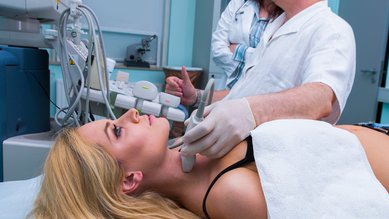
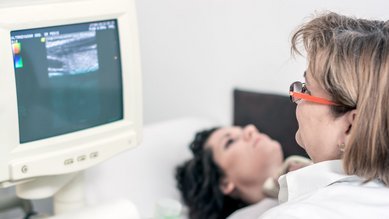
If an adenoma is suspected, the doctor will try to detect it using ultrasound, computed tomography (CT), scintigraphy or a PET scan.
Ultrasound and X-ray scans can be used to check for damage to the kidneys or bones. If a stomach ulcer is suspected, a gastroscopy may be necessary.
What treatments are used for overactive parathyroid glands?
The treatment of an overactive parathyroid gland depends on its causes.
If you have an adenoma but no symptoms, and your blood calcium level is only slightly elevated, you can take a wait-and-see approach. Levels are then checked every 1 to 2 years.
Surgery to remove the adenoma is considered if you have symptoms, damage to the kidneys, bones, or gastrointestinal tract, or an increased risk of a hypercalcemic crisis. Whenever possible, the procedure is then performed using a tissue-sparing (minimally invasive) approach.
In addition, medications can be used for adenomas to slow down hormone production, for example if a procedure is not possible or desired.
If the overactive parathyroid gland is caused by another illness that triggered the calcium deficiency, surgery is not useful. In that case, it is important to first treat the underlying condition.
Some people need long-term calcium and vitamin D supplements to make up for the calcium deficiency – this relieves the parathyroid glands of that task, allowing their hormone production to return to a normal level. If this is not enough, medication can be tried to slow down hormone production in the parathyroid glands.
- Chandran M, Bilezikian JP, Lau J et al. The efficacy and safety of cinacalcet in primary hyperparathyroidism: a systematic review and meta-analysis of randomized controlled trials and cohort studies. Rev Endocr Metab Disord 2022; 23(3): 485-501.
- Deutsche Gesellschaft für Allgemein- und Viszeralchirurgie (DGAV). Operative Therapie des primären und renalen Hyperparathyreoidismus (S2k-Leitlinie). AWMF-Registernr.: 088-009. 2020.
- Deutsche Gesellschaft für Kinderendokrinologie und -diabetologie (DGKED). Primärer Hyperparathyeroidismus (S1-Leitlinie, in Überarbeitung). AWMF-Registernr.: 174-006. 2016.
- El-Hajj Fuleihan G, Chakhtoura M, Cipriani C et al. Classical and Nonclassical Manifestations of Primary Hyperparathyroidism. J Bone Miner Res 2022; 37(11): 2330-2350.
- Gollisch K, Siggelkow H. Asymptomatischer primärer Hyperparathyreoidismus: Operieren oder beobachten? [Asymptomatic primary hyperparathyroidism: Operation or observation?]. Internist (Berl) 2021; 62(5): 496-504.
- Jorde R, Bønaa KH, Sundsfjord J. Primary hyperparathyroidism detected in a health screening. The Trømsø study. J Clin Epidemiol 2000; 53(11): 1164-1169.
- Loscalzo J, Kasper DL, Longo DL et al. Harrison's Principles of Internal Medicine (Vol. 1 & Vol. 2). New York: McGraw-Hill; 2022.
- Miedlich S, Koch CA, Paschke R.Primärer Hyperparathyreoidismus: Heute ein meist asymptomatisches Krankheitsbild. Dtsch Arztebl Int 2002; 99(49).
- Pappachan JM, Lahart IM, Viswanath AK et al.Parathyroidectomy for adults with primary hyperparathyroidism. Cochrane Database Syst Rev 2023; (3): CD013035.
- Schlosser K, Wirowski D.Primärer Hyperparathyreoidismus – Teil 1: Epidemiologie, Anatomie und Symptomatik. Allgemein- und Viszeralchirurgie up2date 2013; 7(1): 23-36.
- Wang X, Shi G, Li G et al.Systematic review of the risk of urolithiasis following parathyroidectomy in patients with primary hyperparathyroidism. Int Urol Nephrol 2023; 26(4): 1217-1225.
- Weber T, Dotzenrath C, Dralle H et al.Management of primary and renal hyperparathyroidism: guidelines from the German Association of Endocrine Surgeons (CAEK). Langenbecks Arch Surg 2021; 406(3): 571-585.
- Ye Z, Silverberg SJ, Sreekanta A et al.The Efficacy and Safety of Medical and Surgical Therapy in Patients With Primary Hyperparathyroidism: A Systematic Review and Meta-Analysis of Randomized Controlled Trials. J Bone Miner Res 2022; 37(11): 2351-2372.