Conditions Shingles
ICD codes: B02 What are ICD codes?
Shingles (herpes zoster) occurs through infection by the varicella-zoster virus. The condition is characterized by sometimes severe pain, burning or itching and a typical skin rash. All cases of shingles should be medically treated.
At a glance
- Shingles (herpes zoster) is a condition caused by varicella-zoster viruses that lie dormant in the body.
- The condition is most prevalent among the elderly and people with a weakened immune system.
- Shingles can present itself on any area of the body. Often, only one area is affected, most commonly the torso or the head.
- The majority of adults affected experience severe pain that is limited to one side of their body. They may also experience itching and burning. A rash usually then breaks out in the painful area.
- It is important to initiate medication-based treatment as soon as possible.
- An effective vaccine is available for people over the age of 60 and those at a higher risk of severe cases of shingles.
Note: The information in this article cannot and should not replace a medical consultation and must not be used for self-diagnosis or treatment.
What is shingles?
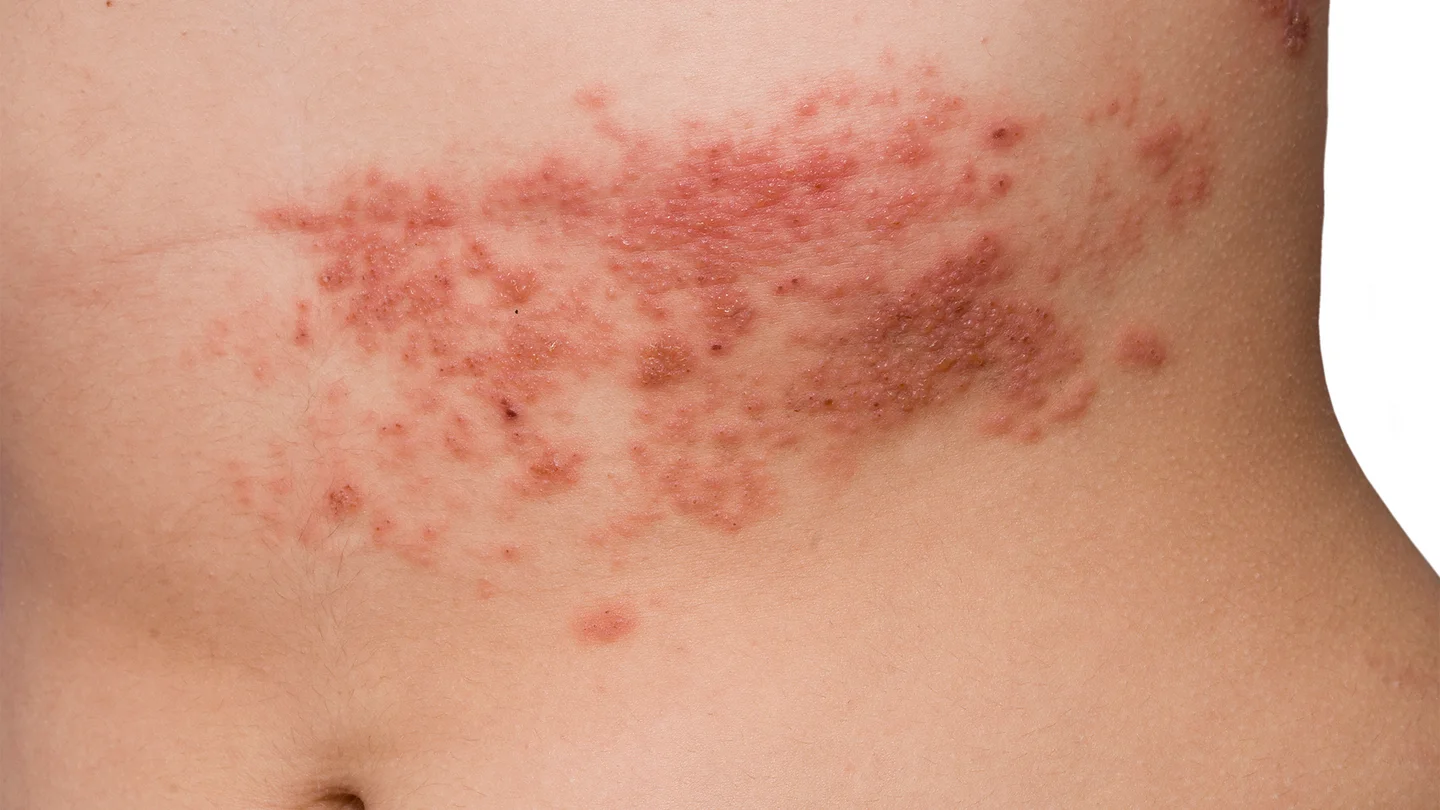
Shingles (herpes zoster) is one of the most common acute skin conditions. In the majority of cases, the initial symptoms include severe pain, burning or itching. Later on, a blister-type skin rash that can spread like a belt develops where the pain is.
One key factor of note is that the symptoms usually only affect one side of the body, i.e. they do not spread across its mid-line. As only one single nerve root is usually affected, the symptoms typically only affect a specific area of the skin.
Shingles can occur anywhere on the body but typically only affects one specific area, most commonly the torso or the head.
Shingles is triggered by the reactivation of dormant varicella-zoster viruses in the body. The first time the person is infected, these viruses cause chickenpox (varicella). This means that anyone who has ever contracted chickenpox can also be affected by shingles.
The elderly, people with a weakened immune system or chronic lung disorder and organ transplant recipients are at a higher risk of shingles.
What causes shingles?
When a person is infected by the varicella-zoster virus for the first time and a rash develops over the entire body, we talk of chickenpox (varicella). Before the general chickenpox vaccine recommendation in 2004, most school-age children were carriers of the virus and went through chickenpox.
Once a person has recovered from chickenpox, the virus nests in the nerve cells of the brain or spinal cord, where it remains, inactive, throughout the person’s life. However, if the immune system is weakened – for example due to aging (immunosenescence), certain medical conditions or medication or other trigger factors such as stress or acute strong sun exposure – the virus can be reactivated. It then travels along the nerve tracts to the skin, where pain and the typical rash develop. At this point it is no longer chickenpox, but shingles.
Video What causes shingles?
This video explains how shingles develops and what symptoms it may cause.
This and other videos can also be found on YouTube
Watch nowThe privacy policy indicated there applies.
How does the infection occur?
Shingles is not as easily transmitted as chickenpox. Only the fluid in the skin blisters is infectious, because it contains the viruses. This means that people who have not had chickenpox and are not vaccinated against it can be infected if they come into contact with the blisters. These people then suffer from chickenpox, not shingles. If a pregnant woman suffers from shingles, her unborn child is at risk of infection.
Important: Patients with shingles can substantially reduce the risk of infecting others by covering the areas affected until they have crusted over or the blisters have healed.
What symptoms does shingles cause?
A skin rash limited to one side of the body, with small, reddish blisters, typically forms, usually in the torso area. However the eye, ear, upper jaw and genital area can also be affected.
Severe symptoms such as pain, burning or itching usually arise in the affected area before the appearance of a visible rash. Abnormal sensations such as tingling or numbness are also possible. Some people can furthermore feel exhausted and develop a high temperature.
Sometimes the typical skin rash fails to occur. In this case, people only experience the characteristic pain, which does not cross the mid-line of the body.
In very rare cases, shingles can affect children although their symptoms are generally mild. For example, the pain is usually less intense than with adults.
Who can become affected and how common is shingles?
Shingles primarily affects people over the age of 50. Estimates indicate that around one in four people will at some time suffer from shingles. In Germany, the condition affects several hundred thousand people every year. People with immune deficiency are more frequently affected. However, even those who are young and healthy can catch shingles.

Important: A person usually only catches shingles once, but repeat infections are also possible.
Who should be vaccinated?
The Standing Committee on Vaccination (Ständige Impfkommission – STIKO) at the Robert Koch Institute recommends that everyone from the age of 60 should be vaccinated against shingles as standard. It also recommends vaccination for people from the age of 50 if they are at a particularly high risk due to an existing underlying condition. This also applies to people who take medication that can weaken their immune system (immunosuppressants).
Underlying conditions of particular note include:
- HIV/AIDS
- rheumatoid arthritis
- systemic lupus erythematodes (SLE)
- chronic inflammatory bowel diseases such as ulcerative colitis and Crohn’s disease
- chronic lung diseases such as COPD and bronchial asthma
- chronic kidney disease
- diabetes mellitus
The statutory health insurance scheme covers the cost of vaccination for these groups. Two doses of the vaccine are required for sufficient protection. The second dose should be administered at least two but no more than six months after the first.
Important: The shingles vaccine is different to the one for preventing chickenpox. There is no need to test the blood to find out whether a person has had chickenpox and is therefore a carrier of the virus before administering the shingles vaccine. Since the chickenpox vaccine has only been available since 2004 it may be assumed that most people aged over 50 today had the illness as a child.
You will find answers to frequently asked questions about the shingles vaccine on the Robert Koch Institute website.
Further information about the shingles vaccine can be found on the website impfen-info.de provided by the Federal Institute for Public Health (BIÖG) – in German only.
How is shingles diagnosed?
Shingles can usually be identified by the characteristic rash and accompanying symptoms such as burning and pain. If these typical symptoms are present, doctors confirm the diagnosis by questioning the person affected and examining their body. In most cases, no further diagnostic procedures are required.
If, on the other hand, less typical symptoms are present, a laboratory test can be performed to prove the presence of the pathogen (varicella-zoster virus – VZV). This applies, for example, if the rash is not restricted to one half of the body or the person has had shingles before.
The laboratory test is performed using fluid from the skin blisters or a blood test, for example. In certain cases, the cerebrospinal fluid can also be tested.
How does shingles progress?
In most cases, the condition first manifests itself through pain in the affected region. People may also feel exhausted and develop a fever. Several days after the onset of these symptoms, a blister-type rash usually appears. This spreads around the body like a belt within a few days. After around a week, the blisters burst, dry out and crust over. It usually takes two to four weeks to fully recover from shingles.
Shingles can also have other consequences for people’s health. The elderly and people with a weakened immune system are at higher risk of complications and a severe case of the condition. Children and young people generally only experience a mild case of shingles.
Several complications can occur in relation to the affected area of skin. For example, it can become bacterially inflamed. It is also possible for scars to remain or for the color of the skin in the affected areas to change, appearing slightly lighter or darker than the surrounding skin.
Pain can still persist even after the rash has disappeared. If the nerve pain goes on for more than three months, this is referred to as post-zoster neuralgia. This affects up to 30 percent of shingles sufferers, especially those who are elderly. The pain can last for several months or even years. In rare cases the pain persists over the long term.
If shingles affects the eye area, it can cause inflammation of the cornea. If, on the other hand, it affects the ear, it can cause a loss of hearing, dizziness and facial paralysis (facial nerve paresis). In rare cases, it can also cause nerve paralysis in the arms and legs.
Severe cases can additionally affect the brain and other organs. The progression sometimes becomes life-threatening.
How is shingles treated?
Shingles should always be treated medically. Early treatment is important to prevent chronic pain and other complications. Treatment primarily involves the use of antiviral medication and strong painkillers.
Treatment with painkillers
Shingles can be extremely painful. Pain therapy aims to completely eliminate the pain if possible and prevent it from becoming chronic. The more quickly treatment begins, the better. The choice of medication depends on the severity and type of pain.
Treatment with antiviral medication
“Antiviral treatment” targets the virus directly. The products used have active ingredients like aciclovir, valaciclovir, famciclovir or brivudine. Antiviral treatment can make the rash heal quicker and shorten the duration of the pain. For treatment to be effective, it is important that it is started within 72 hours.
Antiviral treatment is particularly used in the case of:
- people aged over 50
- shingles in the head-neck area
- severe pain
- a weak immune system
- severe progression or a heightened risk of complications
People with a severe case of shingles or at risk of complications are usually administered antiviral medication intravenously. In most cases, they are admitted to hospital and monitored.
Skin treatment
In the case of shingles, it is also advisable to treat the affected area of skin. This can help to alleviate the symptoms and promote healing. Several gels or solutions with cooling, anti-inflammatory or disinfectant properties can be used to this end, for example polyhexanide-based products.
- cme-Kurs. Update Herpes Zoster. Aufgerufen am 29.07.2025
- Deutsche Dermatologische Gesellschaft (DDG). Diagnostik und Therapie des Zoster und der Postzosterneuralgie. S2k-Leitlinie. AWMF-Registernummer 013-023, 2019. Stand: 24.05.2019.
- Fritsch P., Schwarz T.: Dermatologie Venerologie (3. Auflage). Berlin: Springer, 2018.
- Gesundheitsinformation.de. Gürtelrose. Aufgerufen am 31.07.2025.
- Robert Koch-Institut (RKI). Gürtelrose (Herpes zoster): Antworten auf häufig gestellte Fragen zu Erkrankung und Impfung. Aufgerufen am 31.07.2025.
- Robert Koch-Institut (RKI). RKI-Ratgeber. Windpocken (Varizellen), Gürtelrose (Herpes zoster). Aufgerufen am 31.07.2025.

Reviewed by the German Dermatological Society (Deutsche Dermatologische Gesellschaft e.V.)
As at: