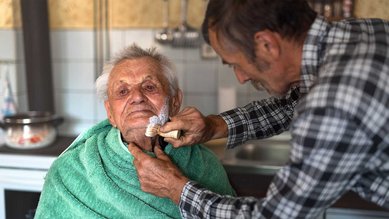
Healthcare Preventive medical benefits – health-promoting retreats
Daily life can cause physical and emotional strain for many people, such as those raising a child alone or providing care to a loved one. The purpose of a health retreat is to ensure that people don't lose sight of their own health in the process of caring for others.
At a glance
- Health retreats aim to prevent both physical and mental health conditions from developing.
- They do so, for example, by offering various relaxation activities, baths, massages and opportunities for light physical exercise.
- The usual duration of a health retreat is three weeks.
- Both outpatient and inpatient health retreats are available, with different eligibility criteria applicable to each.
- Mother-and-child health retreats/father-and-child health retreats and health retreats for family carers are tailored to the specific needs of parents or those providing care to loved ones respectively.
- Health insurance funds may cover the costs of health resort treatments and, in some cases, the costs of an inpatient stay. They will only do so if the health retreat is medically necessary and prescribed by a doctor.


What is a health retreat?
Particular stresses in daily life or at work can, over time, lead to both mental and physical health problems. To prevent this from happening, it may be beneficial to take some time out from daily life and from work before things progress too far. Health retreats are intended to provide people with an opportunity to take time for themselves and to prevent illness. In other words, people go on health retreats before they become ill.
In this way, a health retreat differs from rehabilitation, which seeks to restore a person's health after they become ill or have an accident. To enable a distinction between these two types of treatment, health retreats are sometimes also called preventive health retreats. Note, however, that early signs of declining health must be present in order for a doctor to prescribe a preventive health retreat. As a result, the boundaries between health retreats and rehabilitation may be fluid.
The primary purpose of a preventive health retreat is to enable rest, relaxation and recuperation. People usually attend a health resort for a period of three weeks for this purpose. A longer stay is also possible where this is medically necessary. Health resorts in different locations offer different treatments. For example, some offer massages, baths and opportunities for light physical exercise.

People may attend a health resort on an inpatient or outpatient basis. If you attend an approved health resort as an outpatient, you must find your own accommodation and you only attend the health resort to avail of the treatments and facilities it offers. If you attend as an inpatient, you also have accommodation within the health resort itself and are provided with meals there.
Inpatient health retreats are an option if attending as an outpatient isn't sufficient or feasible. Health retreats are also possible for specific target groups, such as parents or children. Health retreats for parents comprise mother-and-child health retreats, father-and-child health retreats, mother health retreats and father health retreats. Outpatient health retreats can normally be approved once every three years, while inpatient health retreats can be approved once every four years.

Health insurance funds are responsible for preventive medical benefits such as health retreats. Subject to certain preconditions, statutory health insurance funds cover the costs of prescribed health resort treatments as well as the costs of medicinal products, bandages/dressings, therapeutic services and medical aids. Which additional costs are covered and to what extent depends on both the health insurance fund and the type of health retreat in each case. Adults with health insurance are normally expected to contribute statutory co-payments.
Who can avail of a health retreat?
Everyone with statutory health insurance in Germany is, in principle, entitled to a health retreat. In order for statutory health insurance funds to cover the costs, a health retreat must be prescribed by a doctor and must be medically necessary. A health retreat may be medically necessary if:
- a person is at risk of developing an illness due to health risks
- health deterioration due to an existing illness is expected
- a person is likely to become dependent on care
- the healthy development of a child is at risk
In addition, the first signs of a decline in health must already be present. These may include persistent fatigue, a feeling of “burnout”, back pain or sleep disturbances. Health risk such as being overweight or smoking are also relevant when applying for a health retreat. The health retreat may also serve the purpose of helping you to lose weight or quit smoking.
Health risks may also consist of challenging life circumstances that place significant physical or emotional strain on an individual. Examples include:
- raising a child with a disability
- raising a child alone
- being a carer for loved ones
Another prerequisite for having the costs of a health retreat covered is that all treatments and therapeutic services available to you locally have already been exhausted. It must also be considered whether it is actually feasible for you to avail of local options due to your work or family situation. For example, a single working mother may be unable to attend regular appointments for treatments. In situations like these, it may be better for treatments to be provided during the health retreat, which would justify the coverage of costs.
The conditions pertaining to cost coverage by private health insurance funds depend on the level of cover specified in the individual insurance policy.
What types of health retreats are available?
A basic distinction is made between outpatient and inpatient health retreats. There are also health retreats that are aimed at specific target groups, such as parents, children and adolescents or family carers.
Outpatient health retreats
If all medical options available to you locally have already been exhausted, you can then apply for an outpatient health retreat at a health resort. In order for the costs of treatments at the health resort to be covered by insurance, the health resort must be a state-approved health resort. This is referred to as an officially approved health resort. It is up to you to arrange your own travel to the health resort, as well as your accommodation and meals. Outpatient health retreats can be approved once every three years.
Important: Employees should find out in advance whether they are required to take annual leave from their jobs to attend a health retreat. As a rule, employees are entitled to continued payment of their wages while they are availing of preventive medical benefits. If their wages continue to be paid by their employer, they are not required to take annual leave. However, certain conditions must be met for outpatient health retreats – as well as the retreat being deemed medically necessary, the facility where it is taking place must also fulfill certain requirements set out in the German Social Code. Advice on questions relating to employment law is available, for example, from the citizens’ hotline operated by the Federal Ministry of Labor and Social Affairs.
Outpatient health retreats also include special intensive retreats. A retreat of this kind is called a “Kompaktkur” in German. These are aimed at people who meet the criteria for a standard health retreat but who are also diagnosed with a chronic health condition, such as osteoporosis, migraine or osteoarthritis. On such retreats, patients with similar conditions are treated in groups of 10 to 15 people at a time. This allows particular attention to be paid to the needs and requirements that are specific to their health condition. Sessions are organized according to a fixed timetable. These health retreats are particularly intensive and incorporate the same number of therapies as an inpatient health retreat.

Inpatient health retreats
Inpatient health retreats are normally only considered if an outpatient health retreat is not sufficient, possible or appropriate. This may be the case, for example, with people who do shift work or frequently work away from home and who are unable to avail of outpatient treatments in their local area. Inpatient health retreats also include health retreats geared towards specific target groups, such as mother-and-child retreats and father-and-child retreats.
If you attend an inpatient health retreat, you also have accommodation within the health resort itself and are provided with meals there. As a rule, inpatient health retreats can be applied for once every four years.
Important: Employees are entitled to continued payment of their wages while they are attending an inpatient health retreat. This means that they are not required to take days out of their annual leave. Be sure to inform your employer in plenty of time that you are planning to attend a health retreat.
Health retreats for parents
It can be difficult to juggle the demands of work and family life. In particular, constant time pressure often leads to parents feeling overwhelmed and exhausted. A mother-and-child or father-and-child health retreat is specifically designed to meet the particular needs of parents. This type of retreat involves a mother or father staying as an inpatient at a health resort together with their child. A mother-and-child or father-and-child health retreat is primarily designed to promote rest and recuperation for the parent. Therefore, having the child with them must not present an obstacle to the success of the treatment. A parent may bring their child with them on a health retreat rather than going alone for the following reasons:
- The child is also in need of treatment and can be treated alongside the parent at the health resort. In this case, the child requires a separate medical certificate.
- One aim of the health retreat is to improve the relationship or bond between the parent and child.
- It is not a feasible option to separate the child from their mother or father, or it is not possible for the child to be cared for at home without their mother or father.

Children may generally only accompany their parent on a health retreat up to the age of 12. There is no age limit for children with disabilities. Health resorts that facilitate this type of retreat provide childcare and, if necessary, tuition to support schoolwork for the child while the parent is having treatments. The parent spends their free time at the resort with their child.
Mother health retreats and father health retreats are also geared towards the needs of parents but do not include children. These are also inpatient health retreats. They are aimed at parents who still have children aged 17 or younger living at home. There is no age limit for children with a disability.
If you have children under the age of 12 who need to be taken care of while you attend the health retreat, you can apply to your statutory health insurance fund for a home help (“Haushaltshilfe”) or to youth welfare office for family care (“Familienpflege”). To make an application, there must be no other people living in the home who are capable of caring for your children. If necessary, ask your health insurance fund or youth welfare office for advice on this matter. You will find details of support and advisory services under “Advice and support” at the end of this article.
Health retreats for family carers
People who take on the role of carer for a loved one often face particular physical and emotional strain. As a result, they are especially in need of rest, recuperation and time for themselves.
If you are a carer for a loved one, your statutory health insurance fund will cover the costs of a health retreat if the following prerequisites are met:
- The person you are caring for has been assigned a care grade
- You have been providing care for a period of at least 6 months
- You are known to the care recipient's long-term care insurance fund
While there are some options for bringing the care recipient with you on your heath retreat, it is recommended that you attend the retreat alone. This frees up your mind so that you can fully relax and recharge your batteries. Care can be guaranteed for the care recipient for the duration of your health retreat by applying for respite care or short-term care. However, if the person you are caring for still wants to attend the health resort with you, an entitlement to have their costs covered by their long-term care insurance fund has been in place since 1 July 2024.
More information about cost coverage for care recipients accompanying carers on health retreats and general information about health retreats for family carers is available from the Müttergenesungswerk non-profit foundation, which promotes the health of parents and family carers.
What range of health resorts is available?
Germany has more than 350 approved health resorts and health spas, which offer a range of treatments. The location of the health resort often dictates what is available, as treatments typical of the area are generally used. For example, a “Luftkurort” is a health resort with a beneficial climate and health-promoting air quality, while a “Seeheilbad” is a seaside health resort focusing on sea-based treatments. Other resorts offer mineral and thermal springs.
There are also some approved European health resorts outside of Germany. If you are interested in these, you should ask your health insurance fund in advance about what to consider and how the costs are covered.
For an overview of approved health resorts in Germany, see, for example, the website of the “Deutscher Heilbäderverband” (national federation of health resorts).
Can I choose a health resort myself?
If attending an outpatient health retreat, you can normally choose the health resort yourself. It's best to consult with your doctor when deciding which health resort is best suited to your needs.
With inpatient health retreats, the statutory health insurance funds are also required, in principle, to take your wishes into account. However, the health resort must be officially approved. In addition, the treatments on offer at the health resort must meet your medical and personal needs. The requirements that apply to the health resort are specified on your health retreat application.

At the same time, statutory health insurance funds are bound by what is known as the principle of economic efficiency. This means that your health insurance fund may allocate or suggest a different, more cost-efficient health resort location that meets all of the requirements specified in the application. If this happens but you still want to attend your preferred health resort, you may be required to cover the difference in cost yourself. However, it may be worth objecting the decision to not approve your preferred health resort in this case. If you object, you must specify a reason why your preferred health resort is best suited to promoting your health.
It's always best to discuss the resort selection procedure with your health insurance fund in advance.
Which health retreat costs are covered?
Outpatient health retreats
If all necessary preconditions for a health retreat are met, statutory health insurance funds will cover the costs of the treatments and other elements of the therapeutic program at the spa resort if you are attending as an outpatient. This includes medical treatments, prescribed medications, therapeutic services and other health-promoting measures.
Insured adults are generally required to contribute a statutory co-payment for therapeutic treatments and medical prescriptions. The costs of accommodation, meals and travel may be partly covered, depending on the health insurance fund. The finer details are regulated by the statutes of the health insurance funds. For people with private health insurance, the coverage of costs depends on the level of cover agreed in the individual insurance policy.
Inpatient health retreats
In the case of inpatient health retreats, e.g. mother-and-child or father-and-child retreats, statutory health insurance funds not only cover the costs of treatments and health-promoting measures but also the costs of accommodation and meals. Travel costs are also covered, provided that the most cost-efficient means of transport is used.
The statutory co-payment for insured adults is EUR 10 per day, as with all inpatient stays. A maximum co-payment of EUR 10 per day has to be contributed by the insurance holder for travel costs.
Important: If your co-payments for health insurance services exceed a certain proportion of your income, you can be exempted from further co-payments by the health insurance fund.
How can I apply for a health retreat?
The first step is to speak with your doctor about your current health condition. It is relevant to mention both physical and mental symptoms and any other health risks and personal life circumstances. Your doctor will then let you know if you meet the criteria for attending a health retreat.
If your doctor believes that you would benefit from a health retreat, you can request the application forms from your health insurance fund. For mother-and-child or father-and-child programs, the forms are available from doctors’ practices. Complete these forms together with your doctor. If a child is also to receive treatments as part of a mother-and-child or father-and-child health retreat, their pediatrician must also complete a prescription form. Any special requests that apply to the resort can be specified in the application. Finally, submit the forms to your health insurance fund.


What can I do if my health retreat application or my preferred health resort is rejected?
If your statutory health insurance fund rejects your application, it can be worthwhile to lodge an objection. In most cases, objections are successful and the health retreat application is ultimately approved. The deadline for lodging an objection is one month.
First check the reason why your application was rejected. One of the most common reasons for health insurance funds to reject an application is that local treatment options have not yet been fully exhausted by the applicant. Another possibility is that the health insurance fund does not believe that expected the health retreat will improve your health.
When appealing to the health insurance fund, ask your doctor to certify once again that you are in need of a health retreat and to provide specific reasons.
If the health insurance fund does not agree to your preferred health resort location, you don’t necessarily have to accept this either. If this happens, you can reiterate why this specific facility offers the best options for promoting your health.
Objections must be made in written form, usually as a letter. It’s best to send your letter by registered post so that you have proof of sending it. Many health insurance funds allow you to lodge an objection online, for example, using an app. However, it is not sufficient to make an objection by e-mail or phone.
Where can I find more information and advice?
If you are interested in attending a health retreat, you should ask your health insurance fund in advance for information about options and conditions.
You will information as well as details of support and advisory services relating to health retreats for parents and family carers on the website of the “Müttergenesungswerk” non-profit foundation, which promotes the health of parents and family carers.
Advice on health retreats for mothers and fathers is also available from the Catholic Working Group for Mother and Family Convalescence (Katholische Arbeitsgemeinschaft (KAG) der Müttergenesung) operated by the German Caritas Association. It offers online and in-person consultations, as well as an advisory hotline, which is subject to a charge.
Advice on health retreats for parents is also provided free of charge by the Mutter-Kind-Hilfswerk e.V. aid organization run by the German Parity Welfare Association.
The German Red Cross similarly offers advice on mother-and-child and father-and-child health retreats. You can search on the website of the German Red Cross for the district branch closest to you where you can get advice.
Other social and charitable organizations also offer their members advice on topics such as preventive healthcare and health insurance. The internet addresses of social associations can be found in the REHADAT database provided by the German Economic Institute in Cologne (Institut der Deutschen Wirtschaft Köln e.V.).
- Bundesamt für Justiz. Gesetz über die Zahlung des Arbeitsentgelts an Feiertagen und im Krankheitsfall (Entgeltfortzahlungsgesetz) § 9 Maßnahmen der medizinischen Vorsorge und Rehabilitation. Stand: 23.3.2022.
- Bundesamt für Justiz. Sozialgesetzbuch (SGB) Fünftes Buch (V) – Gesetzliche Krankenversicherung. Stand: 25.02.2025.
- Betanet. Vorsorgeleistungen und Vorsorgekuren. Aufgerufen am 17.09.2024.
- Bundesportal des Bundesministeriums des Innern und für Heimat. Ambulante Vorsorgemaßnahme wie eine Kur für gesetzlich Krankenversicherte beantragen. Aufgerufen am 17.09.2024.
- Bundesministerium für Gesundheit. Rehabilitation. Aufgerufen am 17.09.2024.
- Deutsche Rentenversicherung. Bund Die Reha-Zentren. Reha vs. Kur. Aufgerufen am 17.09.2024.
- Deutscher Arbeitskreis für Familienhilfe e.V. Mutter-/Vater-Kind-Kur. Indikationen und Kontraindikationen. Aufgerufen am 17.09.2024.
- Deutscher Heilbäderverband. Deutschland – das Gesundheitsland. Aufgerufen am 23.09.2024.
- Deutscher Heilbäderverband. KurWissen. Aufgerufen am 23.09.2024.
- KAG Müttergenesung. Familienpflege/Haushaltshilfe. Aufgerufen am 23.09.2024.
- Mutter-Kind-Hilfswerk e.V. Rund um die Kur. Aufgerufen am 23.09.2024.
- Müttergenesungswerk. Die Kur für pflegende Angehörige. Aufgerufen am 23.09.2024.
- Müttergenesungswerk. Gesetzliche Grundlagen. Aufgerufen am 23.09.2024.
- Müttergenesungswerk. Zeit für mich - Die Mütterkur und Mutter-Kind-Kur. Vorsorge und Rehabilitation für Mütter. Stand 12.06.2020.
- Pflegewegweiser NRW. Widerspruch einlegen! Aufgerufen am 23.09.2024.
- Umsetzungsempfehlungen des GKV-Spitzenverbandes, der Verbände der Krankenkassen auf Bundesebene und des MDS im Zusammenhang mit Anträgen auf Leistungen zur medizinischen Vorsorge und Rehabilitation für Mütter und Väter nach §§ 24, 41 SGB V. Stand Februar 2012.